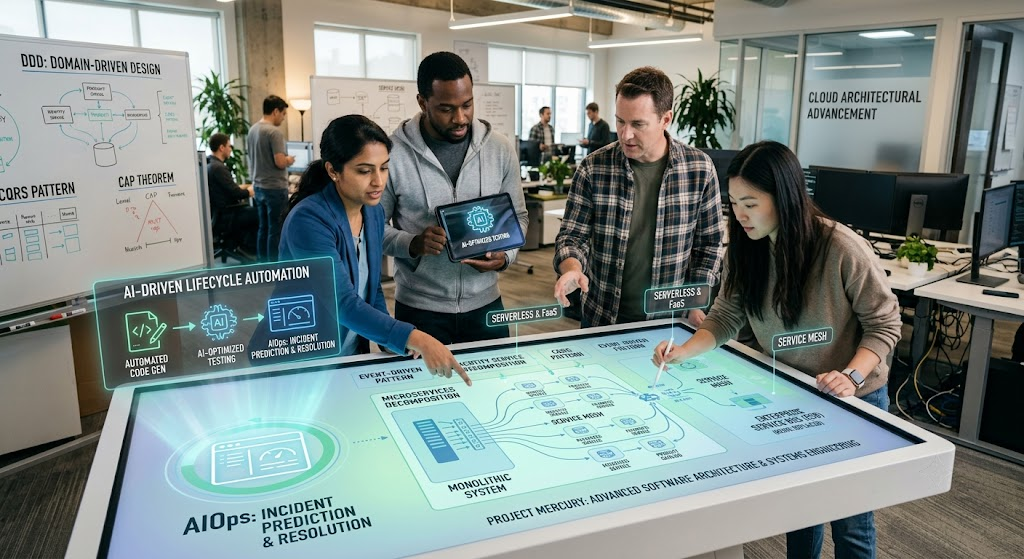
In the contemporary digital economy, software engineering is no longer merely a supporting back-office utility; it is the fundamental core of corporate strategy, operational execution, and competitive advantage. As software systems scale globally to handle hundreds of thousands of concurrent user requests per second and user expectations for zero-downtime performance become non-negotiable, the practices surrounding software design, development, deployment, and operational resilience have undergone a monumental transformation. Building resilient, highly scalable, and maintainable software requires a deep understanding of structural architectural paradigms, clean coding standards, distributed domain design, cloud-native infrastructure, automated delivery pipelines, and the transformative integration of artificial intelligence across the modern engineering lifecycle.
1. Foundational Principles of Modern Software Architecture
Software architecture defines the structural organization of software systems, specifying the explicit relationships between individual application components, communication protocols, data flows, operational constraints, and extension boundaries. A poorly designed architecture introduces systemic rigidity, making future enhancements prohibitively expensive and prone to operational failures.
Cohesion and Coupling
At the core of software design lies the relationship between cohesion and coupling. Cohesion refers to the degree to which elements within a single module belong together functionally. High cohesion ensures that a component focuses strictly on a single, well-defined operational responsibility. Conversely, coupling measures the degree of interdependence between separate software modules. Loose coupling ensures that modifications made within one module do not ripple catastrophically across unrelated components of the system. High cohesion combined with loose coupling forms the bedrock of scalable software architecture.
Domain-Driven Design (DDD)
When building complex enterprise software, bridging the gap between business requirements and technical code implementation is critical. Domain-Driven Design provides a structured strategic framework for managing complex enterprise domain logic:
- Bounded Contexts: Explicit logical boundaries within which a domain model applies uniquely. Differing contexts can maintain distinct definitions for identical terms without creating system-wide naming conflicts.
- Ubiquitous Language: A unified, rigorous language shared identically by domain experts, software architects, and developers to eliminate contextual misunderstandings.
- Entities, Value Objects, and Aggregates: Entities possess unique identifiers that endure across time, Value Objects represent immutable domain attributes defined solely by their values, and Aggregates represent clusters of associated entities treated as unified atomic data units during state changes.
2. Architectural Paradigms and System Topologies
Selecting the appropriate architectural paradigm determines how an application scales, handles operational traffic spikes, and accommodates team growth over time.
Monolithic Architectures: Single-Unit Binaries
Historically, applications were engineered as monolithic structures where user interface rendering, business logic execution, and database access logic coexisted within a single executable binary.
- Modular Monoliths: A well-structured monolithic architecture where internal boundaries are strictly maintained through clean code interfaces. Modular monoliths provide simplified initial deployment pipelines, straightforward end-to-end integration testing, and frictionless early-stage development.
- Monolithic Pitfalls: As enterprise engineering teams expand, monoliths frequently degrade into unstructured codebases. Compilation times increase, deployment cycles become brittle, and horizontal scaling requires replicating the entire application stack even if only a minor background job experiences heavy user traffic.
Microservices Architecture: Autonomous Distributed Services
Microservices solve monolithic scaling bottlenecks by decomposing an application into autonomous, loosely coupled micro-applications structured around distinct business domain capabilities.
- Decoupled Datastores: Each microservice maintains its own isolated database layer, preventing implicit database-level coupling across service boundaries.
- Communication Protocols: Services interact across network boundaries using lightweight synchronous APIs such as REST and gRPC or through high-performance asynchronous event messaging channels.
- Operational Overhead: While microservices enable independent team deployment velocity and granular horizontal scaling, they introduce distributed systems challenges, including network latency overhead, complex distributed transaction handling, and mandatory automated monitoring infrastructure.
Event-Driven Architecture (EDA)
Event-Driven Architectures decouple producers of events from consumers entirely. When state changes occur, producers emit asynchronous event notifications to a central event bus or streaming cluster, such as Apache Kafka or RabbitMQ.
- CQRS (Command Query Responsibility Segregation): A structural pattern that separates read and write data operations into distinct dedicated interfaces and storage engines, optimizing read performance independently from write transaction processing.
- Event Sourcing: Instead of storing only the current state of an entity in a database, Event Sourcing records every state mutation as an immutable append-only sequence of events, providing complete audit trails and point-in-time replay capabilities.
Serverless and Function-as-a-Service (FaaS)
Serverless computing abstracts infrastructure management entirely away from application developers. Cloud environments execute code strictly in response to incoming events or API requests, auto-scaling compute capacity dynamically from zero to thousands of concurrent executions. Serverless models eliminate idle compute costs through sub-second execution billing, though architects must carefully mitigate cold-start latencies and stateless execution constraints.
3. Software Engineering Best Practices & Enterprise Quality Assurance
Maintaining code quality across multi-decade enterprise lifecycles requires adherence to disciplined design strategies and structured automated verification frameworks.
SOLID Design Principles
- Single Responsibility Principle: A class or module should have one, and only one, reason to change.
- Open/Closed Principle: Software entities should be open for extension, but strictly closed for modification.
- Liskov Substitution Principle: Subtypes must be completely substitutable for their base types without altering system correctness.
- Interface Segregation Principle: Clients should never be forced to depend upon methods they do not actively utilize.
- Dependency Inversion Principle: High-level modules should not depend on low-level implementation details; both must depend upon abstract interfaces.
The Comprehensive Testing Pyramid
Robust quality assurance relies on a multi-layered automated testing hierarchy:
- Unit Testing: Fast, isolated tests verifying individual functions, classes, or computational algorithms in complete isolation from external resources.
- Integration Testing: Tests validating seamless communication between coupled software modules, database queries, network sockets, and third-party API integrations.
- Contract Testing: Automated checks ensuring that API producers and API consumers adhere precisely to mutually agreed-upon data payload schemas without requiring full end-to-end environment deployment.
- End-to-End (E2E) Testing: Automated browser or API workflows simulating complete user journeys across fully integrated application environments.
- Chaos Engineering: Proactive testing methodologies that intentionally introduce infrastructure failures—such as terminating virtual instances or delaying network packets—to verify system self-healing resilience in production.
4. CI/CD Pipelines, DevOps, and Platform Engineering
Modern software delivery relies on continuous delivery workflows that automate the operational path from local code commits to production deployment.
Infrastructure as Code (IaC)
Managing cloud infrastructure through manual management dashboards introduces configuration drift, human error, and deployment inconsistencies. Infrastructure as Code tools, such as Terraform and OpenTofu, allow engineers to define cloud server instances, virtual private networks, load balancers, and security firewall rules declaratively using version-controlled text files.
Advanced Deployment Strategies
- Blue-Green Deployments: Maintaining two identical production environments. The Blue environment runs current live traffic while the Green environment receives updated code. Once Green passes validation, router gateways shift user traffic instantly to Green, enabling zero-downtime releases and rapid rollback capabilities.
- Canary Deployments: Gradually routing a small percentage of real user traffic (such as five percent) to a newly deployed software version while monitoring operational error rates. If operational metrics remain stable, traffic is incrementally increased until full deployment is achieved.
- GitOps Workflows: Utilizing version-controlled Git repositories as the absolute source of truth for infrastructure and application deployment states, where automated controllers continuously synchronize actual live cluster states with repository definitions.
5. The Artificial Intelligence Transformation in Software Engineering
Artificial intelligence is fundamentally restructuring how software engineers write, debug, test, and maintain software applications.
Context-Aware AI Coding Assistants
Modern AI coding assistants integrate directly inside Integrated Development Environments. Leveraging deep neural language models trained on massive code repositories, these tools go beyond static auto-completion to offer contextually aware multi-line function generation, automated inline documentation generation, and real-time algorithmic optimizations based on local codebase contexts.
Autonomous AI Agentic Engineering
The industry is rapidly advancing from inline auto-completion tools toward autonomous agentic workflows. Modern software AI agents can receive high-level feature requests or issue tickets, autonomously analyze repository structures, run local build environments, construct missing unit tests, refactor non-compliant code sections, and submit complete pull requests for human review.
AI-Enhanced Security and Refactoring
Machine learning models continuously evaluate code repositories to detect anti-patterns, memory leak conditions, and subtle security vulnerabilities like cross-site scripting or SQL injection hazards long before code reaches production environments. Furthermore, AI agents assist in updating deprecated library dependencies and translating legacy codebases into modern programming languages.
6. Scalability, Reliability, and Site Reliability Engineering (SRE)
Operating enterprise applications at massive scale demands structured approaches to handling state, data persistence, and system telemetry.
Scalable Caching Architectures
Caching frequently accessed data in high-speed, in-memory datastores like Redis or Memcached drastically reduces database read pressures and API response times. Engineering teams implement caching strategies such as Cache-Aside (where application logic reads from cache first and updates cache upon database miss), Write-Through (updating cache and database simultaneously), and Write-Behind (queueing asynchronous database writes to maximize throughput).
Database Sharding and Consistency
As relational databases exhaust vertical compute scaling limits, database sharding partitions dataset rows horizontally across multiple discrete database server nodes based on a designated shard key. Distributed system designers balance consistency and performance by choosing between strict ACID compliance for transactional systems or eventual consistency (BASE) models for hyper-scale distributed stores.
Telemetry and Distributed Observability
Gaining visibility into complex distributed systems requires unified telemetry frameworks structured around three key operational pillars:
- Metrics: Time-series statistical data tracking system resource metrics, throughput, latency distributions, and error percentages.
- Structured Logs: Contextually rich timestamped text records capturing specific execution events across application modules.
- Distributed Tracing: Context-propagated trace identifiers that map the exact end-to-end execution path of individual user requests across multi-tiered microservices networks.
7. Frequently Asked Questions
- How do engineering teams decide between a monolithic and a microservices architecture for a new project?Teams should evaluate organizational maturity, domain complexity, and scaling requirements. Early-stage projects or smaller teams generally benefit from starting with a modular monolith due to minimal operational overhead and rapid iteration capabilities. Transitioning to microservices becomes justified when distinct business domains require independent scaling, separate tech stacks, or autonomous deployment schedules across multiple engineering teams.
- What is technical debt, and what are the best strategies for managing it in production software?Technical debt refers to the implied future refactoring and operational cost incurred by choosing an expedient, short-term software solution over an architecturally optimal design. Teams manage technical debt by conducting regular architecture reviews, maintaining strict code quality gates in CI/CD pipelines, and consistently allocating a fixed percentage (such as fifteen to twenty percent) of every development sprint specifically to technical refactoring and dependency updates.
- What role does API-First Design play in modern multi-platform application development?API-First Design establishes formal API specification contracts (such as OpenAPI or GraphQL schemas) before writing application implementation code. This methodology allows frontend web teams, mobile application developers, and backend engineers to build and test their respective application layers concurrently against mock API servers, significantly accelerating development velocity and reducing integration friction.
- How does event sourcing differ from traditional state-based database storage?Traditional state-based storage overwrites existing database rows to store only the current state of an entity. Event sourcing, conversely, records every individual state mutation as an immutable, time-stamped append-only event entry. The current state of any entity is computed by replaying its historical event stream, providing complete auditability, temporal querying, and high-performance write operations.
- What is the primary difference between continuous delivery and continuous deployment?In Continuous Delivery, every code change that passes automated testing pipelines is automatically compiled, tested, and packaged into a release-ready artifact, but deployment to production requires manual human approval. In Continuous Deployment, every validated code change automatically bypasses manual approval and deploys directly to production environments through automated pipelines.