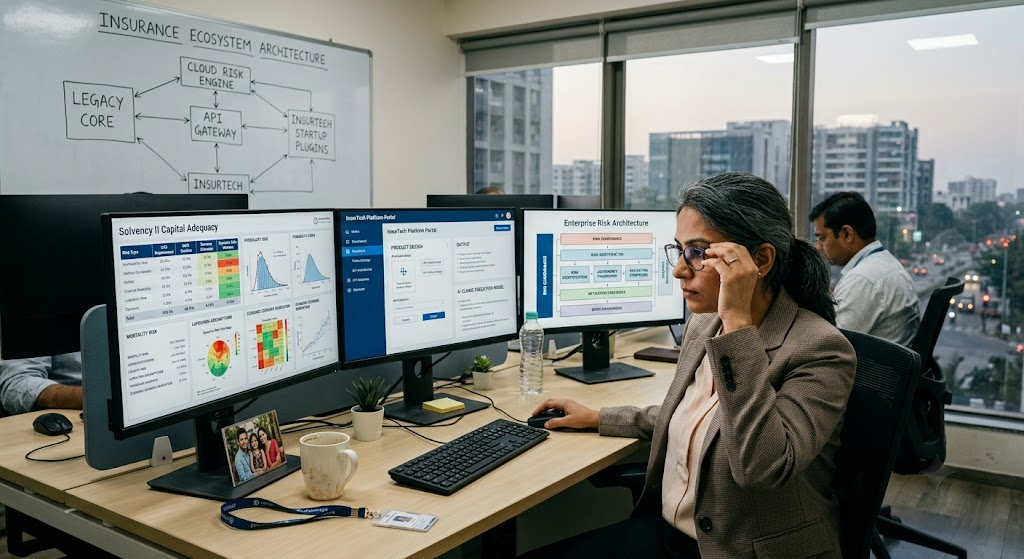
Insurance forms a critical financial stabilization framework within modern global economies. By pooling individual, commercial, and societal risks, insurance structures convert catastrophic, unpredictable financial loss exposures into manageable, predictable operational costs. Engineering resilient insurance ecosystems requires a deep integration of actuarial science, statistical probability modeling, strict regulatory capital adequacy frameworks, advanced risk mitigation strategies, and cutting-edge digital InsurTech platforms.
1. Mathematical and Legal Foundations of Risk Management
Insurance operations rely on mathematical probability theory and foundational legal principles designed to ensure contract integrity and system-wide financial solvency.
Core Legal and Economic Principles
- Principle of Indemnity: An insurance contract guarantees that following an approved claim, the insured party is restored to the precise financial position they occupied immediately prior to the loss event. Insurance contracts are legally structured to prohibit policyholders from profiting from loss occurrences.
- Principle of Utmost Good Faith (Uberrimae Fidei): Both the policy applicant and the insurer are legally obligated to fully disclose all material risk facts accurately. Conscious misrepresentation or concealment of material facts renders the policy contract void.
- Principle of Insurable Interest: An entity can purchase insurance only on assets or individuals where they maintain a verifiable financial interest, meaning they would suffer a direct economic loss if damage or injury occurs.
- Principle of Subrogation: Upon paying a covered loss claim, the insurer acquires the legal right to pursue financial recovery from third parties who negligently caused the underlying damage.
Actuarial Science and Statistical Probability
Insurance operations rely on the Law of Large Numbers. As the total number of independent, exposed risk units (such as vehicles, properties, or lives) within a pooled cohort increases, the actual aggregate loss experience converges closely toward the mathematically expected probability distribution. This statistical predictability allows actuaries to price risk policies accurately across large population pools.
2. Comprehensive Categorization of Insurance Ecosystems
Modern insurance risk engineering spans several primary coverage domains, each featuring distinct loss distribution profiles and regulatory oversight frameworks.
Life Insurance and Capital Protection
- Term Life Insurance: Provides pure financial risk protection over a specified term length. If the insured passes away during the term, the policy disburses a tax-free death benefit to designated beneficiaries. It contains no cash savings component.
- Whole Life and Universal Life: Permanent insurance policies combining guaranteed death benefits with an accumulating internal cash-value savings vehicle, which earns interest over time and can be accessed by the policyholder during their lifetime.
Health and Medical Risk Engineering
Health insurance protects individuals and employer groups against catastrophic medical expenses:
- Deductibles: The annual out-of-pocket financial amount a policyholder must pay for covered medical services before the insurance company begins reimbursing claims.
- Co-Insurance and Co-Payments: Co-insurance represents the percentage split of medical costs (such as 80% paid by insurer, 20% by policyholder) after meeting the annual deductible. Co-payments are fixed dollar fees paid directly at the time of receiving specific services.
- Out-of-Pocket Maximums: The absolute cap on total policyholder health expenditure within a policy year, after which the insurer covers 100% of remaining eligible medical costs.
Property and Casualty (P&C) Insurance
P&C insurance protects physical assets—including commercial real estate, private homes, automobiles, and manufacturing equipment—against loss events like fire, theft, natural disasters, or operational accidents.
- Replacement Cost vs. Actual Cash Value (ACV): Replacement cost coverage pays the full current market cost required to repair or rebuild damaged property using new materials of like kind and quality. Actual Cash Value deducts accumulated physical depreciation from the replacement payout, resulting in lower claim payments.
Commercial Liability and Cyber Risk Architecture
- Directors & Officers (D&O) Liability: Protects corporate executives against personal financial losses resulting from lawsuits alleging managerial errors, breach of fiduciary duty, or corporate governance failures.
- Cyber Liability Insurance: Provides specialized coverage for digital asset loss, legal liability, regulatory fines, forensic investigation costs, and crisis PR expenses resulting from enterprise data breaches, ransomware attacks, or operational network outages.
3. Underwriting Engineering and Actuarial Pricing Frameworks
Underwriting is the analytical process of evaluating risk exposures, determining acceptable coverage terms, and setting premium rates that adequately reflect the underlying statistical loss probability.
The Underwriting Workflow
- Risk Identification: Gathering comprehensive data regarding the applicant’s risk exposure (e.g., medical histories, structural building specs, commercial liability records).
- Loss Run Analysis: Evaluating an enterprise applicant’s historical loss frequency and loss severity trends over multi-year periods.
- Classification and Pricing: Assigning the applicant to a specific statistical risk tier and applying actuarial rate matrices to calculate the mandatory risk premium.
Capital Adequacy and Regulatory Oversight
To prevent insurance company insolvencies during catastrophic loss years, international regulatory frameworks mandate strict capital reserves:
- Solvency II (Europe) and NAIC Standards (USA): Regulatory regimes enforcing Risk-Based Capital (RBC) requirements. Insurers must hold liquid financial capital reserves directly proportionate to the underlying risk profile of their investment portfolios, underwriting exposures, and operational liabilities.
4. Reinsurance, Catastrophe Modeling, and Capital Markets
Primary insurance companies manage major catastrophic events by transferring portions of their risk exposure to global reinsurance entities and capital market investors.
Reinsurance Frameworks
- Treaty Reinsurance: An overarching contract where the reinsurer automatically accepts an agreed percentage of an entire class of risks underwritten by the primary insurer.
- Facultative Reinsurance: Customized reinsurance negotiated separately for a single, exceptional high-value risk exposure (such as a multi-billion-dollar infrastructure project or chemical refining facility).
Catastrophe Bonds (Cat Bonds) and Insurance-Linked Securities (ILS)
Catastrophe bonds allow insurers to transfer extreme tail-risk events (such as major earthquakes or severe hurricane landfalls) directly to institutional capital market investors. If a specified natural catastrophe trigger event occurs, the bond capital is forgiven, and the funds pass directly to the insurer to cover policyholder claims. If no trigger occurs, investors receive attractive coupon interest returns.
5. InsurTech Innovations, Automation, and Digital Transformation
Digital technologies are streamlining legacy insurance practices into dynamic, automated data platforms.
IoT Telematics and Usage-Based Insurance (UBI)
In auto and commercial fleet insurance, telematics sensors and mobile applications capture continuous real-time driving data—including vehicle speed distributions, hard braking frequencies, cornering accelerations, and phone distraction metrics. Insurers utilize these metrics to price policies dynamically, offering lower premiums to safe drivers.
AI-Powered Fraud Detection and Claims Automation
Machine learning models analyze historical claims data to detect complex insurance fraud schemes, organized claims rings, and inflated repair invoices. Furthermore, computer vision algorithms evaluate photo uploads of property or vehicle damage automatically, generating instant repair estimates and accelerating straight-through claims processing.
6. Frequently Asked Questions
- What is the difference between Loss Frequency and Loss Severity in actuarial risk modeling?Loss Frequency measures the total number of claims occurring within a specified policy pool over a given timeframe. Loss Severity measures the average monetary cost associated with each individual claim. Actuaries multiply predicted loss frequency by predicted loss severity to calculate total expected claims losses when establishing baseline policy premiums.
- How does Parametric Insurance differ from traditional Indemnity Insurance?Traditional indemnity insurance pays out claims based on a lengthy post-event assessment of actual physical financial damages incurred. Parametric insurance automatically triggers a pre-agreed financial payout immediately when a verified, objective parameter threshold is breached (such as a wind speed exceeding 150 km/h at a specific weather station or an earthquake exceeding magnitude 7.0), without requiring lengthy manual damage assessments.
- What is the Combined Ratio, and why is it a crucial metric for insurance profitability?The Combined Ratio measures an insurance company’s underwriting profitability by adding its Loss Ratio (claims paid divided by premiums earned) to its Expense Ratio (operational costs divided by written premiums). A combined ratio below 100% indicates an underwriting profit, while a ratio above 100% means the insurer paid out more in claims and operating expenses than it collected in premiums.
- What is a Moral Hazard in insurance underwriting, and how do insurers mitigate it?Moral Hazard occurs when an insured individual or business changes their behavior recklessly because they know their financial losses are covered by an insurance policy. Insurers mitigate moral hazard by requiring deductibles, co-payments, and policy limits, ensuring the policyholder retains a direct financial incentive to prevent losses.
- Why is dynamic weather and climate modeling becoming essential for property insurance pricing?Traditional actuarial models calculated property risks relying almost exclusively on historical multi-decade weather trends. As climate patterns shift, increasing the frequency and intensity of severe storms, wildfires, and flood events, insurers must adopt forward-looking geospatial climate models to price property risks accurately and ensure long-term solvency.