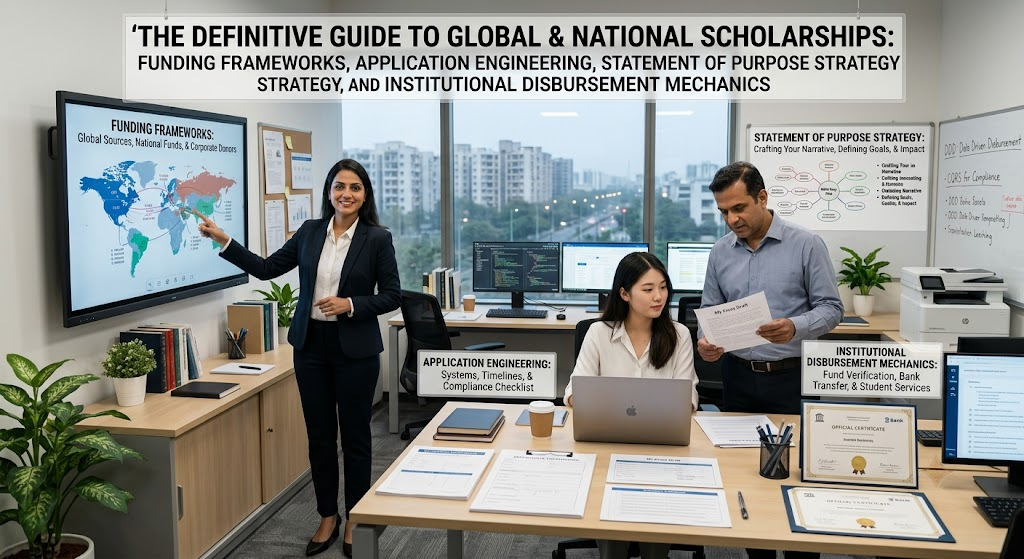
Access to high-quality higher education serves as one of the most effective levers for personal advancement, socioeconomic mobility, and long-term economic security. However, the rapidly escalating costs associated with university tuition fees, specialized instructional materials, advanced research equipment, campus accommodation, and international living expenses create formidable financial barriers for talented students worldwide. Scholarships, fellowships, and research grants provide non-repayable financial capital designed to ensure that intellectual merit, leadership potential, and academic promise are never constrained by personal financial limitations.
1. The Economic Foundations of Higher Education Financial Aid
Understanding the modern educational funding ecosystem requires distinguishing between various financial mechanisms and recognizing how institutions allocate financial aid.
Taxonomy of Financial Support Mechanisms
- Scholarships: Non-repayable monetary awards granted by government ministries, corporate trusts, philanthropic foundations, and academic institutions based on academic excellence, demonstrated financial need, athletic ability, or demographic criteria.
- Research and Academic Fellowships: Non-repayable financial stipends awarded primarily to graduate, doctoral, or post-doctoral scholars to support advanced academic research, field investigations, or institutional teaching assistantships.
- Institutional Grants: Need-based or institutional discount funds awarded directly by colleges to reduce net tuition costs for eligible enrolled students.
- Educational Loans: Repayable debt instruments issued by commercial banks or state lending agencies that accrue compounding interest over time, creating post-graduation financial repayment liabilities.
The Strategic Impact of Non-Repayable Funding
Securing a scholarship provides benefits far beyond basic financial relief:
- Debt Mitigation: Enables graduates to launch professional careers or pursue advanced research without the burden of mandatory monthly debt service payments.
- Academic Merit Validation: Receiving a competitive, peer-reviewed scholarship establishes strong third-party validation of a scholar’s dedication and analytical capability, enhancing future career opportunities.
- Global Professional Networks: Premier scholarship programs grant scholars access to exclusive international alumni networks, executive mentorship initiatives, high-level leadership workshops, and global research collaborations.
2. Comprehensive Taxonomy of Scholarship Programs
Scholarship initiatives are structured across diverse eligibility frameworks, target demographics, and organizational objectives.
Merit-Based Scholarships
Merit-based scholarships evaluate academic performance, standardized examination scores (such as GRE, GMAT, SAT, or regional entrance tests), research publications, patent filings, or national-level extracurricular achievements. Financial background is not a consideration; applicants are ranked purely against competitive objective performance metrics.
Need-Based (Means-Based) Scholarships
Need-based scholarships prioritize financial assistance for students hailing from economically marginalized backgrounds. Selection frameworks focus primarily on verified household income levels, family asset disclosures, and dependent ratios to ensure that higher education remains accessible to low-income households.
Merit-cum-Means Scholarships
Merit-cum-means funding models combine dual evaluation filters. Candidates must satisfy minimum academic grade point average thresholds while simultaneously demonstrating that their total household annual income falls below specified policy limits. This model ensures that financial assistance reaches high-achieving students who face genuine economic constraints.
Demographic, Inclusion, and Diversity Grants
Offered by state ministries and philanthropic trusts, these grants promote educational equity for underrepresented social demographics, female scholars pursuing Science, Technology, Engineering, and Mathematics (STEM) fields, individuals with physical disabilities, and students from under-resourced rural territories.
Flagship International Study-Abroad Fellowships
Governments worldwide fund fully endowed international fellowships to foster bilateral diplomatic ties, cross-cultural exchange, and global research integration:
- The Chevening Scholarship (United Kingdom): Fully funded master’s degree grants covering tuition, living stipends, and travel expenses for emerging global leaders.
- The Fulbright Program (United States): Binational educational exchange grants supporting graduate studies, advanced research, and university lecturing.
- DAAD Scholarships (Germany): Comprehensive funding for international students pursuing postgraduate and doctoral degrees at world-class German universities.
- The Commonwealth Scholarship (Global): Awarded to outstanding talents across Commonwealth member nations for advanced postgraduate study.
- Erasmus Mundus Joint Master Degrees (European Union): Integrated international study grants allowing scholars to study across multiple European university campuses.
3. Strategic Roadmap for Scholarship Application Engineering
Securing competitive scholarships requires a disciplined, multi-stage application methodology executed months in advance of stated application deadlines.
Phase 1: Institutional Research and Eligibility Audit
Applicants must construct a structured database detailing prospective scholarship programs, application windows, eligibility constraints, required documentation, and historical selection ratios. Attempting generic, un-targeted submissions across mismatched schemes yields low success rates.
Phase 2: Document Verification Portfolio Assembly
Maintaining a verified portfolio of standard documentation prevents last-minute technical rejections during portal submissions:
- Officially attested academic transcripts and degree completion certificates.
- Current-year family income verification certificates issued by authorized government tax officials.
- Standardized language proficiency certifications (such as IELTS or TOEFL) for international programs.
- Valid government identification documents with consistent personal naming details across all records.
- Official bonafide student certificates and institutional admission offer letters detailing itemized fee schedules.
Phase 3: Engineering the Statement of Purpose (SOP)
The Statement of Purpose is frequently the decisive narrative component of competitive applications. A compelling SOP must avoid generic, cliché declarations of ambition and instead structure a clear professional narrative:
- The Academic Anchor: Clearly articulate past academic training, specific research projects, and foundational intellectual motivations.
- The Immediate Objective: Detail precisely why the selected academic program or university fits your immediate skill-acquisition goals.
- The Long-Term Impact: Explain how receiving the scholarship will enable concrete contributions to your professional industry, academic field, or local community upon graduation.
Phase 4: Securing Strategic Letters of Recommendation (LOR)
High-impact recommendation letters should be requested from academic mentors, department chairs, or senior professional supervisors who possess direct, prolonged observation of the candidate’s technical capabilities, analytical problem-solving skills, and personal integrity. Generic, template-driven recommendation letters weaken an applicant’s competitive evaluation.
4. Institutional Verification, Direct Benefit Transfer (DBT), and Administrative Mechanics
Modern national scholarship programs rely heavily on centralized digital governance portals to manage applications, verify authenticity, and disburse financial awards.
Centralized Scholarship Portals
National scholarship workflows utilize state-level or national digital portals (such as India’s National Scholarship Portal or unified university financial systems) to streamline verification across academic institutions, local government authorities, and ministry sanction committees.
Direct Benefit Transfer (DBT) and Account Seeding
To eliminate intermediary administrative leakages, corruption, and disbursement delays, government scholarship payouts are increasingly executed via Direct Benefit Transfer protocols. Financial grants are wired electronically directly from state treasuries into the verified bank accounts of selected beneficiaries.
- Aadhaar/NPCI Account Mapping: Beneficiary bank accounts must be actively linked to national identity numbers and seeded within central banking clearing systems (such as the National Payments Corporation of India mapper). Un-seeded accounts fail central automated validation checks, causing grant disbursement failures.
Multi-Tier Application Verification Workflow
- Level 1 (Institutional Verification): The candidate’s college or university scholarship nodal officer verifies bonafide enrollment, attendance records, and transcript authenticity.
- Level 2 (District/Regional Verification): Local government officials validate income certificates, caste/category credentials, and regional residency documentation.
- Level 3 (State/Ministry Sanction): Final state selection committees review verified candidate merit lists, allocate departmental budgets, and release direct electronic payment orders.
5. Frequently Asked Questions
- Can a student simultaneously hold multiple non-repayable scholarships during the same academic year?Policy rules vary depending on sponsoring bodies. Most government and fully funded international scholarships strictly enforce anti-duplication clauses, prohibiting scholars from receiving multiple full-tuition grants concurrently. However, students are often permitted to combine a primary tuition scholarship with minor local book allowances, travel grants, or academic merit prize awards, provided explicit disclosure is made to all granting authorities.
- How do students maintain scholarship eligibility across multi-year academic degree programs?Multi-year scholarship continuation requires annual renewal compliance. Beneficiaries must maintain a specified cumulative Grade Point Average (CGPA), meet minimum mandatory classroom attendance percentages, maintain clean student conduct records, and submit annual renewal applications alongside updated academic transcripts to verify ongoing qualification.
- What are the primary reasons scholarship portals reject student applications during administrative processing?Common causes for portal rejections include minor spelling discrepancies in personal names or dates of birth across identity cards, academic marksheets, and bank account records; expired income certificates; un-seeded or inactive bank accounts; un-attested document uploads; and delayed institutional verification by university nodal officers prior to official portal closing deadlines.
- Is financial aid available for international post-doctoral research projects?Yes. Numerous global foundations and governments offer specialized post-doctoral research fellowships (such as the Marie Skłodowska-Curie Actions in Europe, the Humboldt Research Fellowship in Germany, or the JSPS Fellowships in Japan). These programs fund independent advanced research, laboratory equipment costs, global conference travel, and competitive living stipends.
- How should applicants address gaps in their academic or professional history within scholarship essays?Applicants should address historical timeline gaps with transparent, objective context rather than attempting to conceal them. Focus on describing constructive activities undertaken during the period—such as specialized skill acquisition, independent research, community volunteering, freelance technical projects, or managing family health challenges—highlighting personal resilience, adaptability, and restored commitment to academic goals.