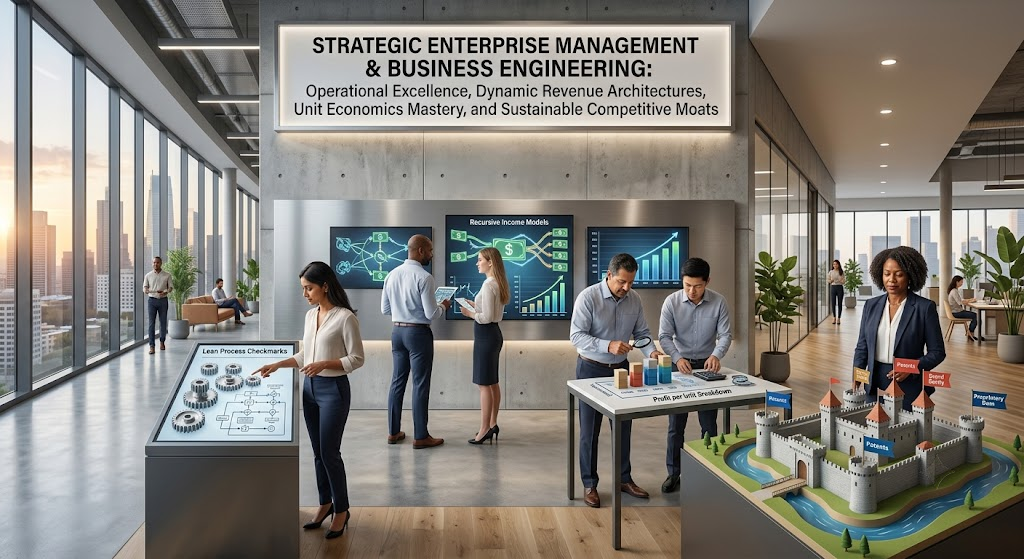
In a modern global economy characterized by rapid technological shifts, volatile capital markets, changing consumer behavior, and shortened product lifecycles, building a resilient enterprise requires far more than aggressive sales tactics. Sustainable business success demands rigorous operational engineering, disciplined unit economics analysis, adaptable digital business architectures, resilient supply chain design, and the strategic construction of defensible competitive moats that preserve long-term enterprise value against aggressive market competitors.
1. Evolution of Modern Business Models and Revenue Architectures
The historical industrial business model operated as a linear value chain: raw materials were sourced, processed into physical products in centralized factories, and distributed through multi-tiered wholesale and retail vendor networks. Digital transformation has introduced highly dynamic, hyper-scalable business frameworks.
Platform and Marketplace Ecosystems
Digital platforms do not directly manufacture physical products or own service inventories; instead, they generate value by building dynamic software environments that connect independent supply-side providers with demand-side consumers.
- Direct and Indirect Network Effects: The intrinsic value of a platform scales exponentially as participation increases. Direct network effects occur when additional users make the network more valuable for other users (such as social networks). Indirect network effects occur when an expanding user base attracts complementary third-party service providers (such as mobile application stores attracting software developers).
Software-as-a-Service (SaaS) and Modern Recurring Revenue Models
SaaS frameworks substitute one-off software licensing sales for predictable, recurring subscription revenue contracts.
- Freemium-to-Enterprise Funnels: Offering basic tier functionality at zero monetary cost to drive viral user acquisition, while gating advanced capabilities, administrative controls, and enterprise-grade security tools behind premium tier subscription tiers.
- Usage-Based Consumption Pricing: Transitioning away from fixed monthly seat licenses toward dynamic consumption metrics—such as data volume processed, API calls executed, or compute hours consumed—aligning revenue growth directly with customer operational expansion.
Direct-to-Consumer (D2C) Strategies
By removing traditional retail and wholesale distribution intermediaries, D2C brands maintain direct, end-to-end control over customer communication channels, brand positioning, dynamic pricing strategies, and granular first-party behavioral analytics. Winning D2C strategies combine frictionless digital storefronts with selective physical experience hubs.
2. Unit Economics and Financial Metrics Engineering
A business cannot maintain long-term solvency purely through top-line revenue expansion; it must achieve positive unit economics—ensuring that each individual product unit or customer account generates net marginal profitability after accounting for direct variable costs.
Customer Lifetime Value (LTV)
  =============================   ≥  3.0 Target Ratio
  Customer Acquisition Cost (CAC)
Customer Acquisition Cost (CAC)
CAC quantifies the total aggregate expenditure on marketing campaigns, advertising media, sales team compensation, and promotional discounts divided strictly by the net number of new customers acquired within a specific accounting period.
Customer Lifetime Value (LTV)
LTV estimates the total net gross profit margin an individual customer account generates throughout its entire commercial relationship with the business.
- LTV Formula Variables: Calculated by combining Average Revenue Per User (ARPU), gross margin percentage, and the average customer churn rate.
Key Performance Metrics for Business Scalability
- LTV-to-CAC Ratio: The benchmark indicator of unit economic sustainability. A ratio of 3:1 or higher indicates healthy commercial expansion. A ratio below 1:1 signifies that the business loses money on every customer acquired, rendering market scaling financially destructive.
- CAC Payback Period: The total number of operational months required for a customer account to generate sufficient gross profit margin to fully recover the upfront capital spent acquiring them. High-performing SaaS businesses target payback periods under twelve months.
- Net Revenue Retention (NRR): Measures the percentage of recurring revenue retained from existing customer cohorts over a specified timeframe, factoring in expansion upgrades, cross-selling, downgrades, and contract churn. An NRR exceeding 100% indicates that existing accounts expand organically without requiring new acquisition spend.
- Burn Multiple: Calculated as net cash burned divided by net new Annual Recurring Revenue (ARR) added over a given period. It measures capital efficiency; lower burn multiples indicate that executive teams generate recurring revenue efficiently per dollar spent.
3. Operational Resilience, Supply Chains, and Process Automation
Global macroeconomic shocks, tariff shifts, and logistical bottlenecks have highlighted the severe operational vulnerabilities inherent in traditional, hyper-lean “Just-In-Time” supply chains focused solely on short-term cost minimization. Modern operational strategy balances lean efficiency with structural resilience.
Resilient Supply Chain Architecture
- Diversified Sourcing (Multi-Shoring): Transitioning away from single-region manufacturing reliance toward multi-region supplier networks, nearshoring (relocating production closer to end markets), and friendshoring (partnering within politically stable allied nations).
- Just-In-Case (JIC) Inventory Management: Strategically maintaining regional buffer stocks of critical raw materials, sub-assemblies, and high-demand finished goods to absorb unexpected supply chain delays without halting manufacturing lines.
- Predictive IoT Supply Telemetry: Integrating Internet of Things tracking sensors across shipping containers and warehouse facilities to gain real-time visibility into inventory positions, temperature controls, and transit bottlenecks.
Robotic Process Automation (RPA) and Workflow Re-Engineering
Enterprises eliminate manual operational overhead by deploying automated software bots to execute high-volume, rules-based administrative tasks—such as vendor invoice matching, cross-system data entry, regulatory compliance reporting, and customer service ticket routing—reducing operational error rates and accelerating processing speeds.
4. Building Sustainable Strategic Moats & Competitive Advantages
A competitive moat represents a set of structural, defensible business advantages that protect an enterprise’s market share and profit margins from being eroded by existing rivals or new market entrants.
Structural Moat Frameworks
- Network Moats: Occur when the value of a platform grows automatically as user volume increases, creating powerful winner-take-most market dynamics that make replication by new entrants extremely difficult.
- Switching Cost Moats: Engineered by embedding software platforms or operational hardware deeply into a client’s daily workflow ecosystem. Switching to a competitor introduces severe operational disruption, mandatory retraining costs, and technical risk, granting the incumbent strong pricing power.
- Cost Advantage Moats: Derived from proprietary manufacturing technologies, structural scale efficiencies, unique geographic access, or exclusive low-cost supplier contracts that competitors cannot replicate, allowing the business to maintain superior profit margins or undercut competitor pricing.
- Brand and Intangible Asset Moats: Encompass legal patents, exclusive regulatory operating licenses, proprietary data assets, and powerful brand reputations that command long-term consumer trust and premium pricing power.
5. Corporate Governance, Mergers & Acquisitions (M&A), and Growth Strategies
Scaling enterprise value requires a disciplined balance between organic business operations and strategic inorganic growth investments.
Inorganic Growth via Mergers & Acquisitions
When organic product development cycles are too slow to keep pace with rapid market evolution, enterprise leaders execute M&A transactions to acquire innovative technologies, enter adjacent geographic markets, or secure strategic technical talent.
- Post-Merger Integration (PMI): The complex operational phase following an acquisition where corporate cultures, software IT infrastructure, sales channels, and administrative departments are unified. Poorly managed PMI represents the primary cause of value destruction in historical corporate acquisitions.
Enterprise Environmental, Social, and Governance (ESG) Protocols
Modern institutional investors evaluate enterprise health using comprehensive ESG risk frameworks alongside traditional financial balance sheets. Robust governance structures, transparent environmental stewardship, and ethical workforce management minimize regulatory fine exposure, attract premium institutional capital, and enhance brand loyalty among modern consumers.
6. Frequently Asked Questions
- What is the difference between organic growth and inorganic growth in enterprise strategy?Organic growth is achieved internally by expanding existing business operations, increasing production volumes, launching new product lines, and acquiring new customers through internal sales and marketing efforts. Inorganic growth is achieved externally through corporate mergers, acquisitions, joint ventures, or strategic equity investments that rapidly absorb external market share, assets, or technologies.
- Why is Premature Scaling considered one of the primary causes of early-stage enterprise failure?Premature scaling occurs when an enterprise allocates massive capital toward aggressive sales acquisition, channel marketing, and staff expansion before achieving verified Product-Market Fit and positive unit economics. Spending heavily to acquire users for an unoptimized product with high churn rates accelerates cash burn without creating sustainable enterprise value.
- How does a company determine whether to “Build, Buy, or Partner” when entering a new technical market?Executive leadership evaluates core internal engineering competencies, time-to-market urgency, total capital requirements, and long-term strategic priority. The enterprise should Build if the technology represents a core long-term competitive moat; Buy if rapid entry is required, internal technical expertise is lacking, and an acquisition target exists at a reasonable valuation; or Partner if the market opportunity is non-core or requires shared risk exposure.
- What is Counter-Positioning as a strategic business advantage?Counter-positioning occurs when a new market entrant adopts a superior, highly efficient business model that established market incumbents cannot copy without severely damaging their existing, highly profitable legacy business operations.
- How do interest rate increases by central banks impact enterprise capital allocation strategies?Higher benchmark interest rates increase the cost of debt corporate borrowing, lower present value valuations of future cash flows, and elevate the hurdle rate required for new capital investment projects. Consequently, enterprise leaders prioritize immediate cash flow generation, debt payoff, and strict cost optimization over aggressive, long-term speculative expansion initiatives.