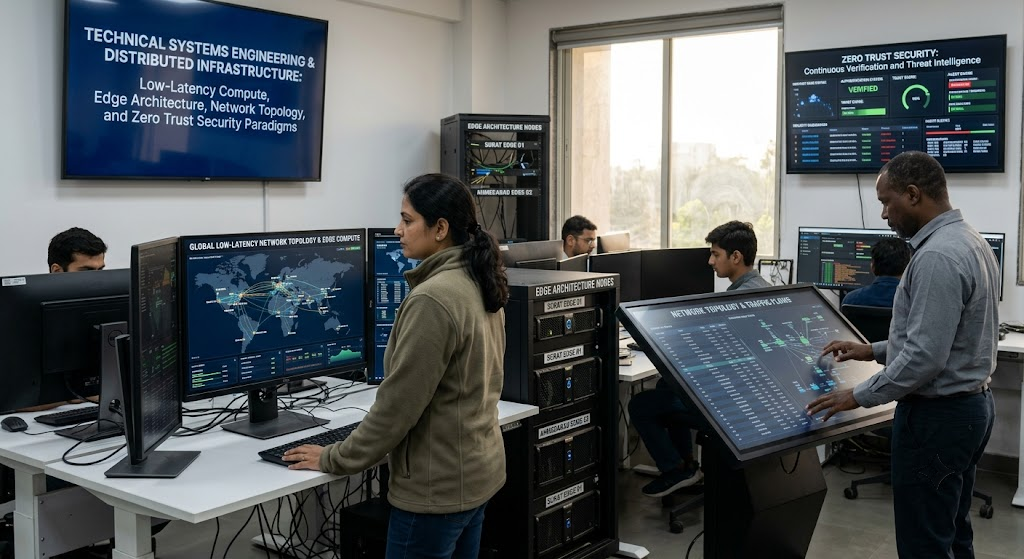
Technical systems engineering forms the foundational infrastructure supporting global cloud computing applications, real-time communications networks, high-frequency financial platforms, and critical industrial automation environments. As global internet traffic scales exponentially and modern applications require sub-millisecond execution responses, software architects and systems engineers must construct resilient compute topologies, low-latency communication networks, scalable distributed datastores, and uncompromising Zero Trust security frameworks.
1. Fundamentals of Modern Compute Systems Architecture
The physical and virtual abstractions governing modern compute environments dictate processing throughput, memory access speeds, latency performance, and administrative flexibility across enterprise operations.
Bare-Metal Compute Infrastructure
Bare-metal deployments execute operating systems directly on physical hardware servers without virtualization hypervisor abstraction layers.
- Use Case Applications: High-frequency financial execution platforms, massive operational relational databases, and high-performance scientific compute clusters where the microsecond operational latencies, hardware interrupt overheads, and noisy-neighbor resource contention associated with hypervisors are unacceptable.
- Direct Hardware Control: Grants application processes direct access to non-volatile memory chips, GPU hardware cores, and high-speed network interfaces, maximizing bare-metal hardware efficiency.
Virtualization and Hypervisor Engineering
Virtualization introduces software hypervisor layers between physical server hardware and execution environments, dividing physical compute resources into multiple isolated Virtual Machines (VMs).
- Type-1 (Bare-Metal) Hypervisors: Software hypervisors (such as VMware ESXi or KVM) that run directly on physical host hardware, providing high virtualization efficiency, hardware access, and strong security isolation between tenant virtual instances.
- Type-2 (Hosted) Hypervisors: Hypervisors executing on top of an existing host operating system, primarily utilized for localized software development and isolated desktop testing.
Containerization and Linux Kernel Primitives
Containers represent a lightweight alternative to full hardware virtualization. Unlike Virtual Machines, which each run a dedicated guest operating system, containers share the host operating system kernel while maintaining strict process isolation.
- Namespaces: Linux kernel mechanisms that provide processes with isolated views of system resources—including process IDs, network interfaces, filesystem mount points, and inter-process communications.
- Control Groups (cgroups): Kernel mechanisms that meter, restrict, and isolate physical resource consumption (CPU time, system memory, disk I/O, network bandwidth) across container process groups, preventing single processes from exhausting host node resources.
2. Distributed Systems Engineering and Network Topologies
Distributed systems unite geographically dispersed, networked compute nodes to operate as a unified computational engine. Designing distributed systems requires managing network latency, protocol overheads, and data consistency across unreliable physical network lines.
High-Performance Network Protocols
- TCP (Transmission Control Protocol): A connection-oriented protocol providing reliable, ordered packet delivery with automated error checking and flow control, essential for applications requiring complete data accuracy.
- UDP (User Datagram Protocol): A lightweight, connectionless protocol prioritizing rapid packet transmission over guaranteed delivery, ideal for real-time video streaming, online voice communications, and competitive online gaming.
- QUIC and HTTP/3: Modern transport protocols operating over UDP that multiplex streams natively without head-of-line blocking, significantly reducing TLS handshake connection setup latencies across mobile cellular networks.
Foundational Theorems of Distributed Computing
- The CAP Theorem: States that any distributed datastore can simultaneously provide only two of three core guarantees: Consistency (every read receives the most recent write or an error), Availability (every non-failing request receives a non-error response), or Partition Tolerance (the system continues operating despite dropped network messages between nodes).
- The PACELC Theorem: Extends CAP by stating that in a system with network Partitions (P), one must choose between Availability (A) and Consistency (C); Else (E), even when the network is operating normally without partitions, one must choose between Latency (L) and Consistency (C).
Network Partition Present?
 ├── YES ──► Choose: Availability (AP) OR Consistency (CP)
 └── NO  ──► Choose: Latency (PA/EL) OR Consistency (PC/EC)
Distributed Consensus Protocols
Maintaining a synchronized, authoritative state across untrusted or failing network nodes requires robust consensus algorithms:
- Raft: Designed for understandable implementation, dividing consensus into explicit leader election, log replication, and safety state machine phases (widely deployed in distributed key-value engines like etcd).
- Paxos: A foundational, highly resilient mathematical consensus framework capable of maintaining state consistency despite node failures and delayed network packet transmissions across distributed networks.
3. Edge Computing, IoT, and Real-Time Systems Architecture
Centralized cloud data centers create physical speed-of-light latency delays when processing real-time telemetry emitted by geographically distributed devices. Edge computing shifts data processing, storage, and real-time analytics physically closer to where data originates.
Edge Compute Topologies
- Local IoT Devices & Sensors: Low-power microcontroller endpoints collecting microsecond physical telemetry (vibration, temperature, velocity) from industrial machinery or medical equipment.
- Regional Edge Gateways & Micro Data Centers: Intermediate regional compute nodes that ingest, filter, and process high-frequency telemetry streams locally, executing real-time machine learning inference engines and executing low-latency local control commands.
- Central Cloud Infrastructure: Receives aggregated, summarized telemetry payloads from edge nodes for long-term historical trend analysis, machine learning model training, and global corporate database updates.
Lightweight Communication Protocols for IoT
Industrial IoT environments rely on lightweight communication protocols optimized for low-bandwidth, high-latency, or constrained network environments, including MQTT (a lightweight publish/subscribe messaging protocol), CoAP (Constrained Application Protocol), and OPC UA for industrial automation interoperability.
4. Cybersecurity Engineering and Zero Trust Architecture
As enterprise infrastructure expands across hybrid multi-cloud environments, mobile workforces, and third-party SaaS integrations, traditional network perimeter defenses (“castle-and-moat”) are insufficient against sophisticated threat actors.
The Core Axioms of Zero Trust Architecture
Zero Trust operates on a fundamental principle: “Never Trust, Always Verify.” Network location is never treated as a implicit signal of trust.
- Explicit Identity Verification: Every user request, service-to-service communication call, and administrative process must be authenticated and authorized explicitly using contextual identity signals (such as device health status, physical location, user role, and MFA factors) before granting system access.
- Least Privilege Access Enforcement: Restricting user and service account access permissions strictly to the exact resources required to perform immediate assigned tasks, preventing lateral movement during security breaches.
- Micro-Segmentation Strategy: Dividing enterprise networks into granular, isolated security zones separated by dynamic internal software-defined firewalls.
- Assume Breach Mentality: Systems are architected under the operational assumption that external perimeters are already compromised, requiring mandatory end-to-end encryption for all data at rest (using AES-256) and data in transit (using TLS 1.3).
5. Site Reliability Engineering (SRE) and Observability Systems
Operating mission-critical systems demands continuous monitoring of operational health, automated fault isolation, and software-driven operational management.
SRE Service Level Frameworks
- Service Level Indicator (SLI): A precisely defined metric measuring the performance of a service in real-time (such as query latency measured in milliseconds or HTTP 5xx error request rates).
- Service Level Objective (SLO): A target reliability threshold defined for an SLI over a specific rolling window (for example, “99.95% of API requests must respond in under 200 milliseconds over a 30-day period”).
- Service Level Agreement (SLA): A legal contract committing a service provider to specific SLO metrics, detailing mandatory financial penalty payouts or service credits if performance targets are missed.
- Error Budget Management: Calculated as 100% minus the SLO threshold. If an SLO target is 99.9%, the 0.1% difference represents the system’s Error Budget. Engineering teams spend their Error Budget to deploy new features rapidly; if the Error Budget is exhausted due to system outages, feature deployments are frozen to focus exclusively on system reliability engineering.
6. Frequently Asked Questions
- What is the difference between horizontal scaling and vertical scaling in systems engineering?Vertical scaling (scaling up) increases the computational capacity of a single server node by adding physical hardware components, such as faster multi-core CPUs, additional RAM, or faster NVMe storage arrays. Horizontal scaling (scaling out) increases overall system capacity by adding additional discrete server nodes into a distributed system pool, utilizing load balancers to distribute traffic across nodes.
- How does a Circuit Breaker pattern improve system resilience in microservice networks?The Circuit Breaker pattern prevents a cascading system failure when a dependent downstream microservice experiences outages or high latencies. When downstream error rates cross a defined threshold, the circuit breaker “trips,” automatically intercepting subsequent calls and returning immediate fallback responses without overwhelming the struggling service, giving it time to recover.
- What is the function of a Reverse Proxy in cloud infrastructure?A Reverse Proxy sits in front of backend web servers, intercepting incoming client HTTP/gRPC traffic. It performs crucial operational tasks including SSL/TLS encryption offloading, load balancing incoming user requests across backend server pools, caching static web assets, filtering malicious web traffic, and protecting internal backend network topologies from direct public internet exposure.
- What is the difference between symmetric and asymmetric encryption?Symmetric encryption uses a single shared cryptographic key to both encrypt and decrypt data payloads (such as AES), offering high computational speed suitable for bulk data storage and rapid data transfer. Asymmetric encryption utilizes a mathematically linked public and private key pair (such as RSA or ECC); data encrypted with the public key can only be decrypted by the corresponding private key, making it ideal for secure key exchange handshakes and digital signatures.
- How does Database Sharding differ from Database Partitioning?Database Partitioning (often called vertical or horizontal table partitioning) divides large tables into smaller, manageable logical segments within a single database instance. Database Sharding distributes horizontal table partitions across multiple physically independent database server nodes and network instances, allowing datastores to scale beyond the physical hardware limits of a single machine.