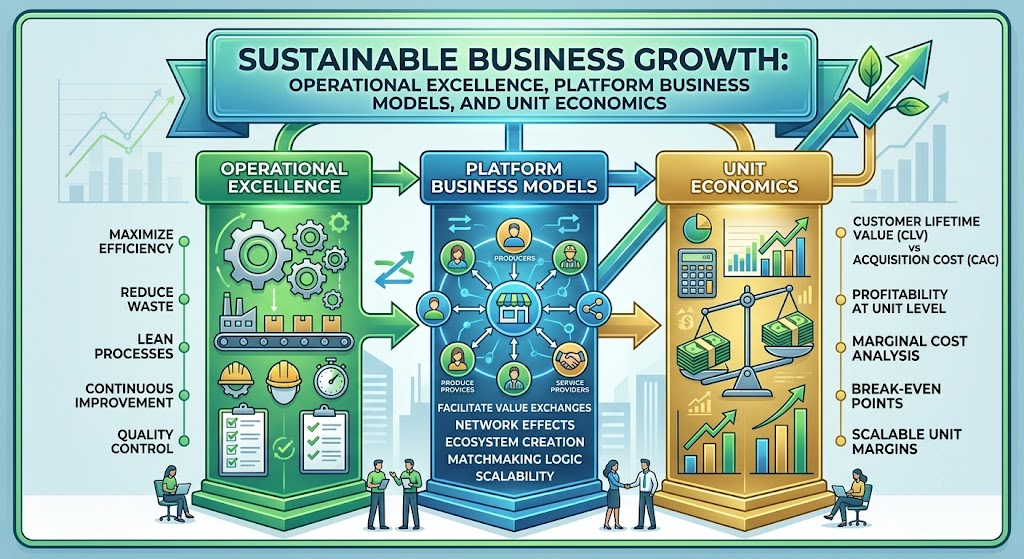
In an era defined by rapid technological disruption, changing consumer behaviors, and macroeconomic shifts, building a resilient enterprise requires far more than compelling sales execution. Modern business strategy combines scalable architecture, sustainable unit economics, robust supply chain design, and adaptive risk management frameworks.
1. Modern Business Models and Digital Platforms
The traditional linear value chain—where raw materials are converted into finished products and distributed through multi-tiered wholesale networks—has been supplemented by platform ecosystem models.
1. Platform & Marketplace Architectures
Platforms derive value not by owning assets, but by orchestrating interactions between external producers and consumers (e.g., rideshare apps, digital marketplaces, cloud service ecosystems). The key driver of platform success is Network Effects—where every additional participant increases the overall value of the network for existing users.
2. Subscription & SaaS (Software-as-a-Service) Frameworks
Subscription models trade one-time transactions for predictable, recurring revenue streams (ARR/MRR). Success hinges on optimizing the balance between Customer Acquisition Cost (CAC) and long-term Customer Lifetime Value (LTV).
3. Direct-to-Consumer (D2C) & Omnichannel Models
By bypassing traditional retail intermediaries, D2C brands maintain direct control over customer relationships, brand identity, and proprietary behavioral data. Modern D2C strategies integrate online channels with selective physical retail footprints to optimize customer acquisition costs and build long-term brand equity.
2. Operational Mastery and Unit Economics
A business cannot survive on revenue growth alone; it must achieve sustainable unit economics—the fundamental profitability of a single unit of sale.
                          +-----------------------------------+
                          |     UNIT ECONOMICS FORMULATION    |
                          +-----------------+-----------------+
                                            |
         +----------------------------------+----------------------------------+
         |                                                                     |
         v                                                                     v
+----------------------------------+                         +----------------------------------+
|    CUSTOMER LIFETIME VALUE (LTV) |                         |  CUSTOMER ACQUISITION COST (CAC) |
| LTV = (ARPU * Gross Margin) /    |                         | CAC = Total Marketing & Sales /  |
|       Churn Rate                 |                         |       New Customers Acquired     |
+----------------------------------+                         +----------------------------------+
                                            |
                                            v
                         +-------------------------------------+
                         |      HEALTHY BUSINESS TARGET:       |
                         |          LTV / CAC >= 3.0           |
                         +-------------------------------------+
Deconstructing Unit Economics Principles
- Customer Acquisition Cost (CAC): Total sales, marketing, and advertising expense divided by the total number of new customers acquired within a specific period.
- Customer Lifetime Value (LTV): Net profit generated from an average customer over their entire commercial engagement with the company.
- LTV/CAC Ratio: A fundamental health indicator for high-growth businesses. An LTV/CAC ratio of 3:1 or higher generally reflects sustainable marketing efficiency and scalable growth dynamics.
- Payback Period: The time required for a customer to generate sufficient gross margin to fully recover the initial cost of acquiring them. A payback period under 12 months is widely targeted in scalable business models.
3. Supply Chain Resilience and Process Automation
Global market volatility has underscored the operational risks of hyper-lean, “Just-In-Time” (JIT) supply chains focused purely on cost reduction. Modern supply chain strategy balances efficiency with structural resilience.
Key Strategies for Supply Chain Resilience
- Multi-Sourcing & Regionalization: Shifting from single-source manufacturing hubs to diversified, regional suppliers (“nearshoring”) mitigates geo-political disruptions and ocean transport delays.
- Predictive Inventory Management: Utilizing machine learning demand forecasting models to optimize safety stock levels based on real-time consumer trend data, macroeconomic indicators, and logistics performance.
- Process Automation & Workflow Optimization: Implementing enterprise workflow automation tools to reduce manual back-office overhead, streamline vendor onboarding, and accelerate order processing workflows.
4. Key Performance Indicators (KPI) Matrix
| Strategic Area | Primary Metric | Target Formula / Standard | Strategic Importance |
| Financial Health | Gross Profit Margin | [(Revenue - COGS) / Revenue] * 100 | Measures core manufacturing/delivery profitability |
| Growth Efficiency | Magic Number (SaaS) | [Net New ARR (Qtr) * 4] / Sales & Mktg Spend (Prev Qtr) | Scores the capital efficiency of sales investments |
| Customer Retention | Net Revenue Retention (NRR) | [(Starting ARR + Expansion - Churn - Contraction) / Starting ARR] | Scores growth generated from existing customer cohorts (>110% ideal) |
| Liquidity & Survival | Net Burn Rate & Runway | Cash Balance / Monthly Net Cash Loss | Determines months of operational survival remaining before requiring capital |
5. Frequently Asked Questions (FAQs)
Q1: What is the primary cause of early-stage business failure during scaling?
Premature scaling—allocating heavy capital to customer acquisition and marketing before achieving proven Product-Market Fit (PMF)—is a leading cause of early-stage business failure. Scaling before retention rates stabilize typically leads to rapid cash burn.
Q2: How does a business protect its competitive advantage?
Sustainable competitive advantages (“moats”) are built through structural barriers: proprietary network effects, high switching costs for customers, unique intellectual property, cost advantages achieved through scale, or strong brand equity.
Q3: How should companies balance short-term profitability with long-term innovation?
Successful companies employ dual-operating frameworks (often called the Three Horizons Model): Horizon 1 focuses on optimizing core profitable operations, Horizon 2 scales emerging opportunities, and Horizon 3 invests in long-term disruptive research and development.