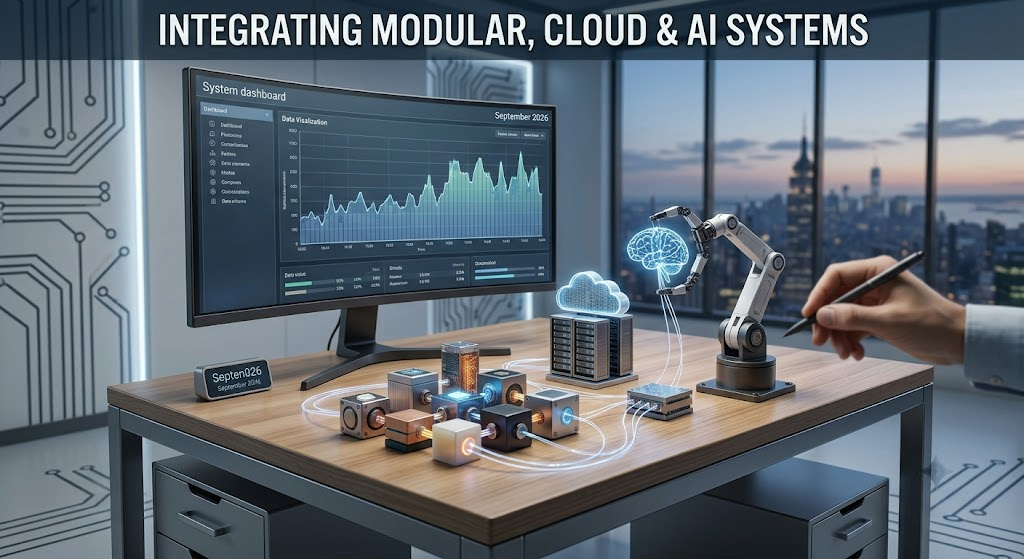
In the contemporary digital economy, software is no longer merely a supporting business utility; it is the fundamental core of corporate strategy, operational execution, and competitive advantage. As systems scale globally and user expectations for zero-downtime performance become non-negotiable, the practices surrounding software design, development, and deployment have undergone a monumental shift. Building resilient software requires a deep understanding of architectural paradigms, cloud-native infrastructure, automated delivery pipelines, and the transformative role of artificial intelligence in the engineering lifecycle.
1. The Evolution of Software Systems Architecture
Software architecture defines the high-level structure of software systems, specifying the relationships between components, data flows, and design constraints. Historically, applications were engineered as single, monolithic binaries containing the complete set of user interfaces, business logic, and database access layers.
Monolithic vs. Microservices vs. Serverless
- Monolithic Architecture:Monoliths simplify early-stage development, end-to-end testing, and deployment due to unified codebase dynamics. However, as organizations scale, monoliths create significant operational friction: long compile times, tightly coupled dependencies, single-point-of-failure risks, and horizontal scaling bottlenecks where the entire application must be replicated even if only one module faces high load.
- Microservices Architecture:Microservices address monolith constraints by decomposing applications into autonomous, loosely coupled services bounded by business contexts (Domain-Driven Design). Each microservice maintains its own dedicated database and communicates via lightweight REST APIs, gRPC, or asynchronous message brokers (e.g., Apache Kafka, RabbitMQ). This design enables independent deployments, technology stack flexibility, and granular horizontal scaling.
- Serverless & Event-Driven Architecture:Serverless computing removes virtual server provisioning entirely, allowing developers to execute event-triggered code blocks (FaaS—Function-as-a-Service, such as AWS Lambda or Google Cloud Functions). Serverless shifts infrastructure management, auto-scaling, and capacity planning to cloud vendors, optimizing costs through sub-second execution-based billing.
2. Cloud-Native Development and DevOps Engineering
Modern software systems are built to thrive within cloud environments. Cloud-native development emphasizes containerization, orchestration, continuous delivery, and infrastructure automation.
Containerization and Orchestration
Containers package application code alongside system dependencies, runtime environments, and configuration files. Docker standardized containerization, eliminating environment discrepancies between development environments and production infrastructure.
For large-scale application management, Kubernetes serves as the dominant orchestration system. It automates container scheduling, dynamic auto-scaling, self-healing instance replacement, service discovery, and rolling upgrades across distributed cloud clusters.
CI/CD Pipelines and Automated Testing
Continuous Integration and Continuous Delivery (CI/CD) pipelines convert manual software releases into automated, repeatable workflows:
- Source Control Management (SCM): Developers push code modifications to centralized repositories (GitHub, GitLab, Bitbucket) using strict branching models.
- Automated Testing Suites: Every commit triggers unit tests, integration tests, static code analysis (e.g., SonarQube), and vulnerability scans.
- Artifact Compilation & Staging: Validated code compiles into container images, registered in secure registries, and deployed to staging environments.
- Production Deployment Strategies: Advanced deployment strategies—such as Blue-Green (instant traffic switching between identical environments) or Canary releases (gradual traffic routing to evaluate system health)—minimize deployment risk.
3. Artificial Intelligence in the Software Lifecycle (DevAI & Agentic Systems)
Artificial Intelligence is fundamentally altering software construction, shifting developer focus from boilerplate syntax writing to higher-level architectural design and algorithmic optimization.
- AI-Assisted Code Generation: Tools integrated into IDEs act as real-time pair programmers, generating context-aware functions, autocompleting complex patterns, and converting natural language prompts into executable code routines.
- Automated Refactoring & Static Analysis: Machine learning models evaluate codebases for anti-patterns, performance bottlenecks, and security flaws (such as SQL injections or buffer overflows), proposing corrective patches prior to code review.
- Agentic Software Development: Autonomous AI agents are evolving from basic syntax suggestions to handling complete multi-step issues: reading repository issue tickets, generating feature branches, writing unit tests, running continuous integration validation, and opening pull requests for human architectural review.
4. Security, Observability, and Maintainability
As software architecture grows distributed, operational complexity expands exponentially. Ensuring system integrity demands robust observability and security practices.
Modern Observability Stack (Telemetry)
Observability relies on three primary data pillars:
- Metrics: Numeric time-series values measuring CPU utilization, memory consumption, latency, and error rates (monitored via Prometheus and Grafana).
- Logs: Structured, timestamped event records emitted by services, centralized for root-cause troubleshooting (via Elastic Search, Logstash, Kibana, or Fluentd).
- Distributed Traces: Visualizations tracking a single end-user request across dozens of microservices, pinpointing exact performance bottlenecks (via OpenTelemetry, Jaeger, or Zipkin).
DevSecOps and Zero Trust Security
Security must be integrated throughout the development lifecycle rather than addressed as a post-production check. DevSecOps mandates automated dependency scanning, secrets management (e.g., HashiCorp Vault), identity and access controls (OAuth 2.0 / OpenID Connect), and Zero Trust networking where every internal service request must be explicitly authenticated and authorized.
5. Architectural Paradigms Comparison Matrix
| Feature | Monolithic Architecture | Microservices Architecture | Serverless Architecture |
| Development Complexity | Low (Unified codebase) | Moderate to High | Low to Moderate |
| Deployment Mechanism | Single monolithic build | Independent per-service pipelines | Granular function deployments |
| Scalability Profile | Vertical or full-tier horizontal | Granular per-service scaling | Automatic micro-scaling |
| Fault Isolation | Poor (Process crash affects all) | High (Faults isolated to service) | Maximum (Isolated per execution) |
| Operational Overhead | Low operational management | High (Requires Kubernetes/Service Mesh) | Minimal infrastructure management |
| Best Suited For | MVPs, small teams, lower complexity | Large enterprises, complex domains | Event-driven micro-tasks, APIs |
6. Frequently Asked Questions (FAQs)
Q1: Should startups start with microservices or a monolith?
Startups should generally begin with a well-structured “modular monolith.” Early-stage products undergo frequent domain changes. Refactoring a monolith is significantly faster than moving logic and schemas across distributed microservice boundaries before product-market fit is established.
Q2: What is technical debt, and how should engineering teams manage it?
Technical debt represents the future cost of refactoring incurred by prioritizing fast code delivery over optimal design. Engineering teams manage technical debt by allocating 15–20% of every development sprint to refactoring, updating dependencies, and expanding unit test coverage.
Q3: How does API-first design benefit software development?
API-first design establishes clear interfaces between frontend, backend, and third-party systems before implementation begins. This enables frontend and backend teams to work in parallel against mock API contracts, accelerating delivery timelines and reducing integration mismatches.