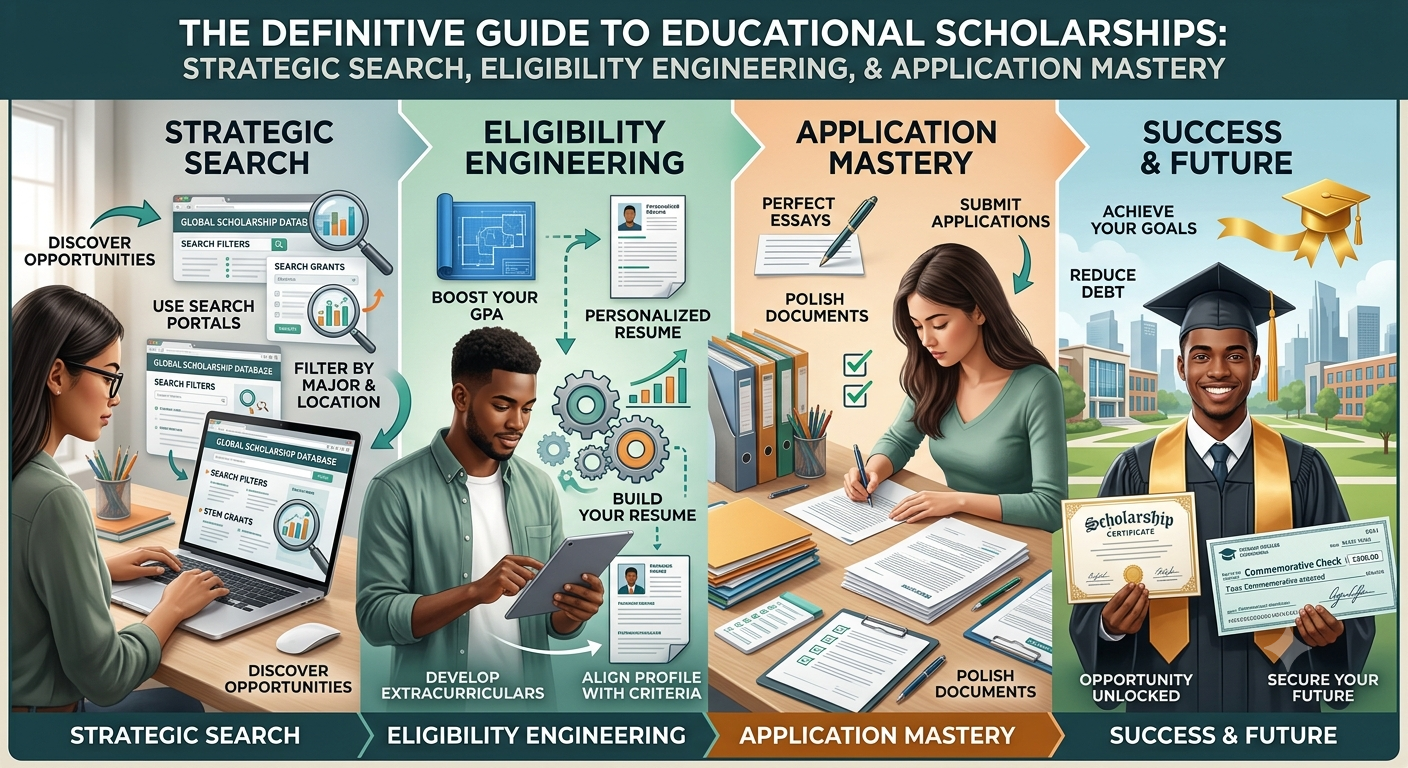
Access to quality education remains one of the most powerful catalysts for socioeconomic advancement. However, the rising cost of tuition, specialized course materials, housing, and international study options presents a significant barrier for talented students. Scholarships provide non-repayable financial funding designed to ensure academic potential is not constrained by personal financial circumstances.
1. The Structure of Educational Funding
Scholarships differ fundamentally from other educational financial mechanisms. Understanding these distinctions is critical for effective academic planning.
Scholarships vs. Educational Loans vs. Fellowships
- Scholarships: Merit-based, need-based, or category-specific grants awarded to pre-degree, undergraduate, or postgraduate students to offset tuition and living costs.
- Educational Loans: Financial agreements provided by banks or specialized institutions requiring principal repayment with interest post-graduation.
- Fellowships: Advanced grants awarded to postgraduate and doctoral scholars, typically tied to research responsibilities, teaching assistantships, or institutional projects.
2. Major Categories of Scholarships
Scholarships are structured around specific institutional goals, socio-economic priorities, and demographic targets.
                                  +-----------------------+
                                  | SCHOLARSHIP TYPOLOGY  |
                                  +-----------+-----------+
                                              |
        +------------------+------------------+------------------+------------------+
        |                  |                  |                  |                  |
        v                  v                  v                  v                  v
+---------------+  +---------------+  +---------------+  +---------------+  +---------------+
|  Merit-Based  |  |  Need-Based   |  | Merit-cum-    |  | Category/     |  | Study Abroad  |
|  (Academic)   |  |  (Financial)  |  | Means Grants  |  | Inclusivity   |  | International |
+---------------+  +---------------+  +---------------+  +---------------+  +---------------+
Merit-Based Scholarships
Awarded strictly on academic excellence, standardized test scores, or intellectual achievements. Family income is not evaluated; selection hinges entirely on competitive academic rank, research papers, or specialized entrance exam performance.
Need-Based (Means-Based) Scholarships
Designed for students from socio-economically disadvantaged households. Applicants must demonstrate financial hardship via certified income documentation issued by designated tax or revenue authorities.
Merit-cum-Means Scholarships
Combine academic cutoffs with financial ceilings. Applicants must maintain a designated academic average (e.g., above 60%–75%) while demonstrating that aggregate family annual income falls below established income caps.
Category, Social Equity, and Diversity Grants
Offered by governments and philanthropic foundations to encourage representation among historically marginalized groups, including minority communities, female scholars in STEM fields, differently-abled individuals, and rural applicants.
International Research and Global Exchange Grants
Prestigious, fully-funded grants covering overseas tuition, international travel, visa costs, health insurance, and monthly living stipends (e.g., Chevening, Fulbright, DAAD, Commonwealth, and Erasmus Mundus).
3. Step-by-Step Strategic Framework for Scholarship Applicants
Applying for competitive scholarships requires a structured method rather than late-stage submission.
  Phase 1: Profile & Document Pre-Audit
  └── Match identity details across all academic and banking records

  Phase 2: Scheme Discovery & Eligibility Mapping
  └── Identify local, national, corporate, and university-specific grants

  Phase 3: Essay/SOP Drafting & Peer Review
  └── Draft tailored Statements of Purpose highlighting resilience and ambition

  Phase 4: Portal Submission & Multi-Tier Verification Tracking
  └── Submit well ahead of deadlines and follow up with Nodal Verification Officers
Phase 1: Institutional & Document Readiness
Before opening an application portal, assemble a verified digital portfolio of standard requirements:
- Identity proof (Aadhaar Card, Passport, or National ID).
- Academic transcripts and passing certificates from Grade 10 through current qualifications.
- Official annual income certificate issued for the current financial year by an authorized revenue officer.
- Proof of admission, student ID card, fee structures, and current bonafide student certificates.
- Active, single-holder bank account registered with Aadhaar/NPCI seeding for automated Direct Benefit Transfer (DBT).
Phase 2: Writing an Impactful Statement of Purpose (SOP)
Many competitive and international scholarship decisions depend on personal essays or SOPs.
- Articulate Concrete Goals: Clearly define your chosen academic field, long-term career vision, and societal impact.
- Frame Financial Constraints Constructively: Focus on personal resilience, proactive initiatives, and how funding will remove specific hurdles.
- Align with Grantor Values: Research the sponsoring foundation or government department and highlight how your ambitions match their organizational mission.
Phase 3: Administrative Follow-Through and Verification
Submitting an application online is only the initial milestone. Applicants must proactively notify their educational institution’s designated Scholarship Nodal Officer. Applications proceed through three verification stages:
- Institutional Verification: Validates enrollment, attendance, and marksheets.
- District/State Verification: Validates revenue documents, caste/domicile records, and income thresholds.
- Financial Disbursal: Funds route through central banking interfaces directly into beneficiary accounts via Direct Benefit Transfer.
4. Direct Comparison: Scholarship Types and Frameworks
| Parameter | Government National Portals | Corporate Foundation Grants | University Institutional Grants |
| Primary Goal | Social equity, mass education access | CSR impact, skill building | Attracting top global/regional talent |
| Competition Level | Extremely high (Millions of applicants) | High (Selective regional focus) | Moderate to High (Institution-bound) |
| Income Thresholds | Strict caps (e.g., < ₹2.5L to ₹8L) | Flexible caps based on criteria | Often variable or merit-focused |
| Disbursement Method | Direct Benefit Transfer (DBT) | Direct bank transfer / Demand Draft | Direct tuition fee waivers |
| Renewal Requirements | Passing marks + annual income proof | High GPA maintenance + progress reports | High academic standing (e.g., GPA > 3.5) |
5. Frequently Asked Questions (FAQs)
Q1: What is NPCI bank account seeding, and why is it essential for government scholarships?
NPCI (National Payments Corporation of India) seeding links a specific bank account to a citizen’s central identity database. Unlike basic account linking, NPCI mapping enables automated Direct Benefit Transfer (DBT) payouts from government treasuries directly into the active account without intermediary processing.
Q2: Can a student hold two scholarships simultaneously?
Most government frameworks explicitly forbid receiving two state or central merit scholarships at the same time (“double-dipping”). However, students are often permitted to combine a tuition fee waiver with a minor maintenance stipend or non-governmental scholarship, provided both schemes explicitly allow it.
Q3: What should I do if my application status shows “Defective”?
A “Defective” status indicates an error or illegible upload flagged by a verification officer. Log into the application portal immediately, review the officer’s notes, re-upload the corrected document, and re-submit the application before the defect-correction window closes.