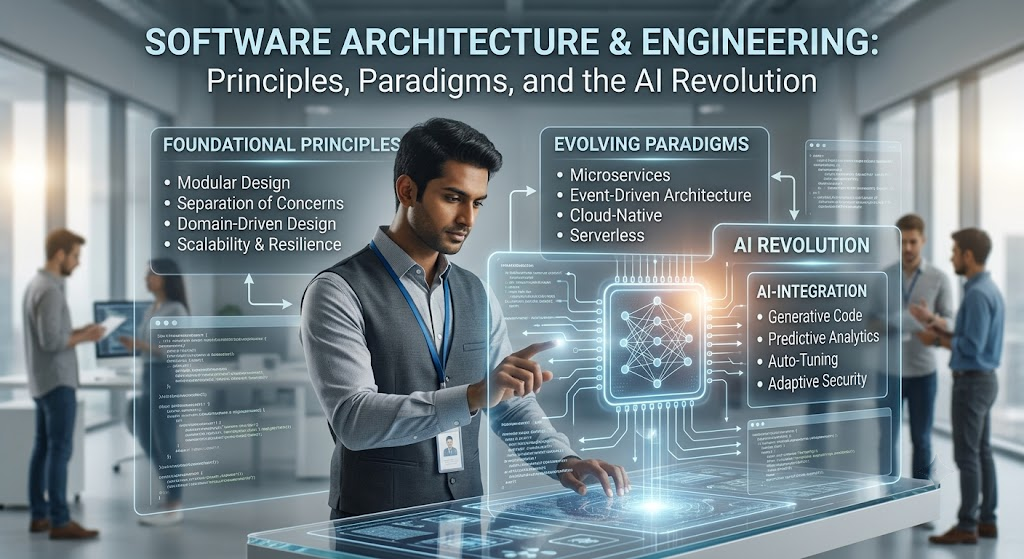
In the contemporary digital economy, software is no longer merely a supporting utility; it is the fundamental core of corporate strategy, operational execution, and competitive advantage. As software systems scale globally to handle millions of concurrent user requests and user expectations for zero-downtime performance become non-negotiable, the practices surrounding software design, development, and deployment have undergone a monumental shift. Building resilient, scalable software requires a deep understanding of structural architectural paradigms, cloud-native infrastructure, automated delivery pipelines, and the transformative role of artificial intelligence in the modern engineering lifecycle.
1. The Evolution of Software Architectural Paradigms
Software architecture defines the structural organization of software systems, specifying the relationships between individual components, data communication flows, and operational constraints. Historically, applications were engineered as single, monolithic binaries containing the complete set of user interfaces, business logic, and database access layers.
Monolithic Architecture
Monoliths simplify early-stage development, end-to-end integration testing, and deployment due to unified codebase dynamics. However, as software scale expands, monoliths create significant operational friction. Long compilation times, tightly coupled code dependencies, single-point-of-failure risks, and horizontal scaling bottlenecks—where the entire application stack must be replicated even if only one background module faces high traffic—frequently impede long-term agility.
Microservices Architecture
Microservices address monolith constraints by decomposing applications into autonomous, loosely coupled services organized around specific business capability contexts. Each microservice maintains its own dedicated database layer and communicates with other services through lightweight REST APIs, high-performance gRPC interfaces, or asynchronous event streams using message brokers like Apache Kafka and RabbitMQ. This approach enables independent deployment schedules, technology stack flexibility, and precise horizontal auto-scaling.
Serverless Architecture
Serverless computing eliminates virtual server provisioning entirely, allowing developers to execute event-triggered functions through Function-as-a-Service environments. Serverless paradigms shift infrastructure maintenance, auto-scaling, and capacity planning directly to cloud providers, optimizing operational costs through sub-second, execution-based billing models.
2. Cloud-Native Development and DevOps Engineering
Modern software applications are engineered to thrive within dynamic cloud environments. Cloud-native engineering emphasizes containerization, orchestration, continuous delivery pipelines, and programmatic infrastructure management.
Containerization and Orchestration
Containers isolate application code alongside required dependencies, system libraries, and configuration settings. Docker standardized containerization, eliminating environment discrepancies between localized development systems and production infrastructure. For enterprise application management, Kubernetes serves as the primary orchestration engine, automating container scheduling, dynamic auto-scaling, self-healing pod replacement, service discovery, and rolling deployment updates across distributed compute clusters.
CI/CD Pipelines and Automated Delivery
Continuous Integration and Continuous Delivery pipelines convert manual software updates into automated, repeatable release workflows. Developer code pushes to centralized repositories trigger automated static code analysis, vulnerability scanning, and automated testing suites. Validated builds are compiled into container images, published to secure registries, and deployed to staging or production environments using zero-downtime deployment strategies such as Blue-Green switching or gradual Canary rollouts.
3. Artificial Intelligence in the Software Lifecycle
Artificial intelligence is fundamentally altering how software is conceived, authored, and maintained. AI integration shifts developer focus from manual boilerplate syntax writing to higher-level architectural design and algorithmic problem-solving.
- Context-Aware Code Generation: AI-driven coding assistants integrate directly into Integrated Development Environments, generating contextually relevant code snippets, auto-completing complex functions, and translating natural language specifications into functional code blocks.
- Automated Static Analysis and Refactoring: Machine learning models analyze code repositories to detect anti-patterns, performance bottlenecks, and security vulnerabilities like SQL injections or buffer overflows, proposing corrective patches before code reviews occur.
- Autonomous Agentic Systems: Emerging software agents are expanding beyond basic inline suggestions to handle complex multi-step technical issues. These agents can read issue tickets, generate dedicated feature branches, construct unit tests, run integration checks, and open detailed pull requests for human review.
4. Observability, Security, and Maintainability
As software environments become increasingly distributed, tracking system health and ensuring operational resilience requires structured observability and proactive security practices.
Observability Frameworks
System observability relies on three primary telemetry pillars: time-series metrics tracking system resource consumption and error frequencies; structured event logs capturing detailed execution context; and distributed traces mapping individual end-user transactions across complex multi-service networks to identify performance latency bottlenecks.
DevSecOps and Zero Trust Security
Security practices must be embedded throughout every phase of the development cycle rather than treated as a final audit step. DevSecOps mandates automated dependency scanning, secrets management via secure key vaults, strict identity management protocols, and network micro-segmentation ensuring that internal network traffic is authenticated and authorized continuously.
5. Frequently Asked Questions
- Should early-stage startups adopt microservices immediately?Startups should generally begin with a modular monolith architecture. Early-stage applications undergo frequent domain changes, and refactoring a single codebase is significantly faster than restructuring network boundaries and database schemas across multiple microservices prior to achieving clear product-market fit.
- What is technical debt, and how should engineering teams manage it?Technical debt represents the future operational and refactoring costs incurred by prioritizing rapid delivery over optimal software architecture. Engineering teams manage technical debt by reserving a dedicated portion of every development cycle for code refactoring, system dependency updates, and automated test expansion.
- How does API-first design improve software delivery?API-first design establishes explicit data contracts and communication interfaces between frontend applications, backend services, and external integrations before writing feature code. This approach allows frontend and backend teams to develop independently against mock API interfaces, accelerating parallel development schedules.