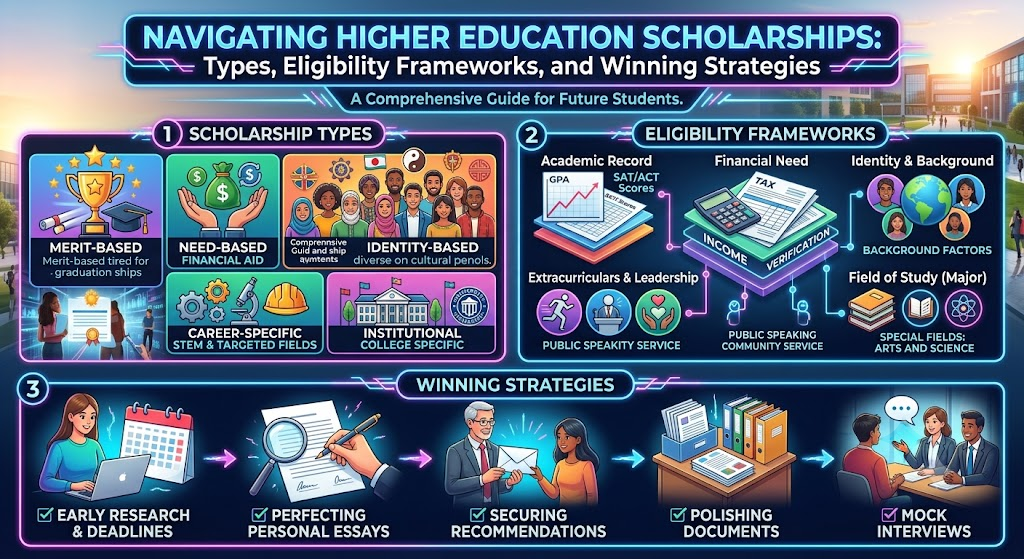
Access to quality higher education is a powerful catalyst for personal advancement, social mobility, and long-term economic stability. However, the rising cost of academic tuition, specialized course materials, campus housing, and international education presents a substantial financial hurdle for students worldwide. Scholarships provide vital non-repayable financial funding designed to ensure that intellectual talent and academic ambition are not constrained by personal economic challenges.
1. The Fundamental Structure of Educational Funding
Scholarships differ fundamentally from other educational financing options. Understanding these core distinctions is essential for long-term academic planning.
Scholarships vs. Educational Loans vs. Research Fellowships
Scholarships are non-repayable monetary awards granted by governments, corporate foundations, non-profit organizations, and academic institutions based on academic performance, financial need, or specific talent criteria. Unlike educational loans, scholarships create no debt obligations or future interest repayments. Research fellowships, while also non-repayable, are primarily awarded to graduate or doctoral scholars to support advanced research, teaching assistantships, or specific academic studies.
Strategic Benefits of Scholarship Support
Beyond immediate financial relief, winning a competitive scholarship offers several long-term advantages:
- Debt-Free Career Foundations: Graduates enter the professional workforce or pursue further academic research without the burden of ongoing loan repayments.
- Academic and Professional Distinction: Securing a competitive scholarship serves as a strong signal of dedication, leadership potential, and intellectual capability on professional resumes.
- Access to Specialized Global Networks: Many prestigious scholarship programs grant recipients access to exclusive mentorship initiatives, alumni associations, and professional development workshops.
2. Comprehensive Categorization of Scholarship Programs
Scholarship initiatives are structured around diverse eligibility requirements, demographic goals, and organizational objectives.
Merit-Based Scholarships
Merit-based scholarships evaluate academic excellence, standardized examination results, research publications, or leadership achievements. Applicants are selected based on academic performance and competitive rankings, regardless of family income background.
Need-Based (Means-Based) Scholarships
Need-based scholarships prioritize financial assistance for students from economically disadvantaged backgrounds. Applicants must submit official documentation verifying family annual income thresholds to qualify for consideration.
Merit-cum-Means Scholarships
Merit-cum-means scholarships integrate academic performance requirements with financial income limits. Candidates must maintain a specified academic grade point average while demonstrating that their family’s aggregate annual income falls below established eligibility limits.
Category, Inclusion, and Diversity Grants
Offered by government bodies and non-profit funds, these scholarships promote educational equity for underrepresented groups, female students pursuing STEM disciplines, individuals with disabilities, and rural applicants.
International Study Abroad Fellowships
Designed for students pursuing overseas degrees, these highly competitive grants cover international tuition, flight expenses, health insurance coverage, and monthly living stipends. Prominent global examples include the Chevening, Fulbright, DAAD, and Commonwealth Scholarship programs.
3. Step-by-Step Strategic Application Framework
Securing a competitive scholarship requires a structured, multi-stage application plan rather than rushed, last-minute submissions.
Stage 1: Document Organization and Profile Matching
Before initiating applications, candidates should assemble a verified portfolio of standard supporting documentation:
- Government-issued identification records with updated personal information.
- Official academic marksheets and graduation certificates from secondary school onward.
- Current-year income certificates issued by authorized government revenue officials.
- Institutional admission confirmation letters, course fee structures, and active bonafide student certificates.
- Active, personal bank account details mapped for direct electronic transfer of funds.
Stage 2: Crafting a Compelling Statement of Purpose
Many competitive scholarship decisions rely heavily on personal essays or Statements of Purpose. Candidates should articulate clear academic objectives, detail career ambitions, explain personal background context objectively, and demonstrate alignment with the sponsoring organization’s core mission.
Stage 3: Verification and Institutional Follow-Up
Submitting an application online is only the first step. Candidates must ensure that their educational institution’s scholarship officer verifies their application records. Applications typically undergo institutional review, administrative verification, and final funding approval before awards are disbursed directly into beneficiary bank accounts.
4. Common Application Mistakes and Practical Tips
- Overlooking Small Local Grants: Many applicants focus exclusively on national or international programs while ignoring local community, corporate social responsibility, or institutional grants that offer lower competition ratios.
- Inconsistent Identity Details: Minor spelling discrepancies in names or birth dates across marksheets, identity cards, and bank account records often cause automated portal verification rejections.
- Delayed Submissions: Online scholarship portals experience high traffic near deadline dates, frequently leading to technical glitches or failed submissions. Completing applications early ensures adequate time to resolve unexpected portal errors.
5. Frequently Asked Questions
- Can students attending private universities apply for government scholarships?Yes. As long as the private university is duly recognized by official government education authorities and regulatory boards, eligible students can apply for applicable government and private scholarship schemes.
- What is an Aadhaar-seeded or NPCI-linked bank account?An NPCI-seeded bank account is connected to a central government clearing system using a unique national identity number. This configuration enables automated, secure Direct Benefit Transfer payments directly from government treasuries into student accounts without manual delays.
- How do students maintain scholarship eligibility across multi-year degree programs?Multi-year scholarships generally require annual renewal processing. Students must maintain a minimum grade point average, satisfy attendance benchmarks, and submit previous academic transcripts alongside current enrollment receipts each academic year.