 By admin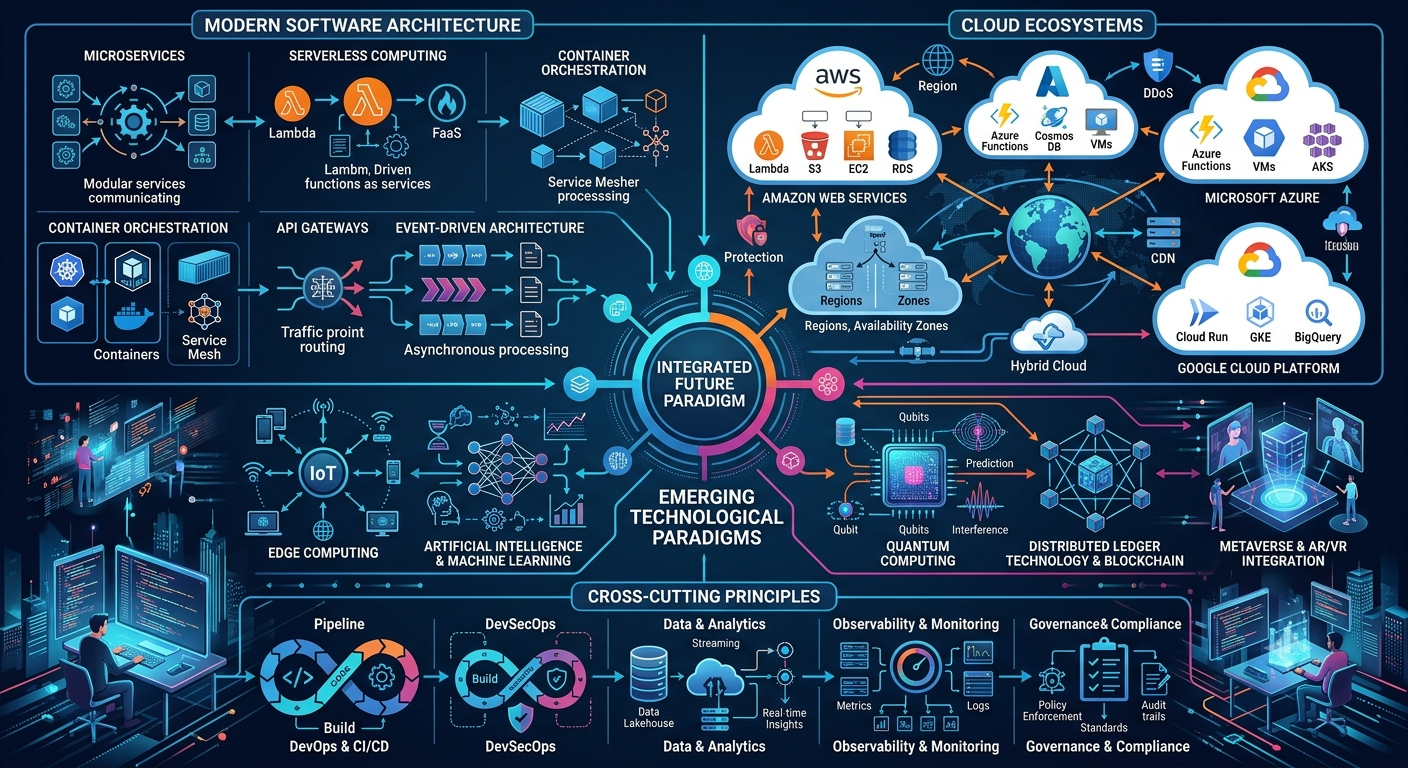
The rapid acceleration of digital innovation has transformed technology from a supportive business function into the foundational driver of global commerce, communication, and operational efficiency. In modern enterprise environments, technological capability is defined by the resilience of system architectures, the security of network infrastructures, the intelligence of automated algorithms, and the scalability of cloud platforms. Understanding the core technical domains, engineering paradigms, and emerging technology ecosystems is essential for developers, IT leaders, and organizations aiming to build scalable, future-proof digital solutions.
1. The Evolution of Software Architecture
Software architecture forms the structural blueprint of any digital application. Over the past two decades, software systems have transitioned from centralized, tightly coupled applications toward distributed, highly decoupled, and event-driven ecosystems.
Monolithic Architecture                Microservices Architecture
┌───────────────────────────┐          ┌──────────┐  ┌──────────┐
│  UI / Presentation Layer  │          │ UI / Web │  │ Mobile   │
├───────────────────────────┤          └────┬─────┘  └────┬─────┘
│  Business / Domain Logic  │               └──────┬──────┘
├───────────────────────────┤                      ▼
│  Data Access / Database   │            ┌──────────────────┐
└───────────────────────────┘            │  API Gateway     │
                                         └─────────┬────────┘
                                   ┌───────────────┼───────────────┐
                                   ▼               ▼               ▼
                             ┌──────────┐    ┌──────────┐    ┌──────────┐
                             │ Auth Svc │    │ Order Svc│    │ Pay Svc  │
                             └────┬─────┘    └────┬─────┘    └────┬─────┘
                                  ▼               ▼               ▼
                             ┌──────────┐    ┌──────────┐    ┌──────────┐
                             │ DB Auth  │    │ DB Order │    │ DB Pay   │
                             └──────────┘    └──────────┘    └──────────┘
Monolithic Systems
In a traditional monolithic architecture, all components—user interface handling, business logic, authorization, and database access—are combined into a single unified code base and deployment unit.
- Advantages: Simplified early-stage development, straightforward debugging, and simple initial deployment pipeline.
- Limitations: Poor horizontal scalability, tight coupling leading to high blast radiuses during failures, long build times, and rigid technology lock-in.
Microservices Architecture
Microservices break a application into autonomous, loosely coupled services organized around specific business capabilities. Each service operates independently, manages its own database, and communicates via lightweight protocols such as REST APIs, gRPC, or message brokers (e.g., Apache Kafka, RabbitMQ).
- Advantages: Independent deployment cycles, localized fault isolation, granular horizontal scaling, and technical flexibility (polyglot architecture).
- Challenges: Increased operational complexity, distributed data management, network latency, and challenging end-to-end monitoring.
Serverless and Event-Driven Computing
Serverless computing (Function-as-a-Service or FaaS, such as AWS Lambda or Google Cloud Functions) removes the need for explicit server management. Execution is entirely event-driven, scaling automatically from zero to thousands of concurrent requests while charging strictly per millisecond of compute execution.
2. Artificial Intelligence, Machine Learning, and Data Pipelines
Artificial Intelligence (AI) and Machine Learning (ML) have shifted from experimental research fields into operational production systems powering computer vision, natural language processing, predictive analytics, and automated decision-making.
The Modern AI/ML Lifecycle
Building and deploying production-grade AI involves a multi-stage pipeline known as MLOps (Machine Learning Operations):
- Data Ingestion & Cleaning: Raw data is extracted from disparate databases, APIs, and stream processing engines, cleaned, and standardized to prevent data drift and bias.
- Feature Engineering & Embedding: Converting unstructured input (text, images, audio) or structured variables into numerical vector representations that machine learning models can process.
- Model Training & Fine-Tuning: Executing optimization algorithms (such as stochastic gradient descent) across high-performance compute clusters (GPUs/TPUs) to minimize prediction error.
- Validation & Bias Audit: Evaluating model performance using metrics such as Precision, Recall, F1-Score, and Mean Squared Error while verifying safety guardrails.
- Inference & Serving: Deploying trained models via low-latency REST or gRPC endpoints to handle real-time predictions or asynchronous batch jobs.
Retrieval-Augmented Generation (RAG) Architecture
For enterprise applications utilizing Generative AI and Large Language Models (LLMs), Retrieval-Augmented Generation (RAG) combines pre-trained language capabilities with proprietary private datasets without requiring full model retraining.
User Query ──► Vector Embedding ──► Vector Database Search ──► Relevant Context ──► LLM Prompt ──► Response
- Vector Databases: Systems like Pinecone, Milvus, and Qdrant index high-dimensional embeddings to perform vector similarity searches in milliseconds.
- Context Injection: Relevant documents retrieved from the vector store are dynamically injected into the LLM context window to generate factual, domain-specific answers with reduced hallucination risks.
3. Cloud Infrastructure, Containerization, and DevOps
Modern infrastructure management relies on cloud environments to provide elastic, high-availability compute, storage, and networking resources globally.
Public, Private, and Hybrid Cloud Models
| Cloud Model | Core Characteristics | Primary Use Case |
| Public Cloud (AWS, Azure, GCP) | On-demand multi-tenant infrastructure managed by major cloud providers. High elasticity, global network presence. | Scalable web applications, big data analytics, rapid prototyping. |
| Private Cloud | Dedicated infrastructure hosted on-premise or in private datacenters. Full hardware-level control. | Highly regulated industries (defense, central banking, healthcare). |
| Hybrid / Multi-Cloud | Combination of public cloud scalability with on-premise security or multi-vendor redundancy. | Disaster recovery, legacy application modernization, vendor lock-in mitigation. |
Containerization and Orchestration
Containers package application code alongside its specific system binaries, dependencies, and configuration files, ensuring identical runtime execution across local development environments, testing servers, and cloud clusters.
- Docker: The industry-standard containerization platform used to build lightweight, isolated container images.
- Kubernetes (K8s): The leading open-source container orchestration system that automates deployment, scaling, health-checking, load balancing, and self-healing of containerized workloads across node clusters.
Infrastructure as Code (IaC) and CI/CD
Modern operations follow software engineering best practices by declaring infrastructure configurations as version-controlled code.
- Infrastructure as Code (IaC): Tools like Terraform and Pulumi allow developers to provision cloud instances, virtual private networks (VPCs), firewalls, and managed databases declaratively using code rather than manual dashboard operations.
- Continuous Integration & Continuous Deployment (CI/CD): Automated pipelines (built on platforms like GitHub Actions, GitLab CI, or Jenkins) automatically compile code, execute static code analysis, run automated test suites, and deploy software changes straight to staging or production environments upon code commits.
4. Cybersecurity Frameworks and Threat Prevention
As enterprise systems become increasingly interconnected and distributed, protecting digital assets, user data, and infrastructure against sophisticated cyber threats is critical.
                      ┌─────────────────────────────────┐
                      │    Zero Trust Security Core     │
                      └────────────────┬────────────────┘
                                       │
        ┌──────────────────────────────┼──────────────────────────────┐
        ▼                              ▼                              ▼
┌───────────────┐              ┌───────────────┐              ┌───────────────┐
│ Identity (IAM)│              │ Encryption    │              │ Network Segmentation│
│ Multi-Factor  │              │ In-Transit &  │              │ Least Privilege│
│ Authentication│              │ At-Rest       │              │ Isolation     │
└───────────────┘              └───────────────┘              └───────────────┘
Zero Trust Architecture (ZTA)
Traditional network security relied on a perimeter model (“perimeter defense”), assuming that everything inside the internal network was trustworthy. Modern security architecture follows a Zero Trust strategy: “Never Trust, Always Verify.”
- Explicit Identity Verification: Every access request—regardless of whether it originates inside or outside the corporate network—must be authenticated, authorized, and encrypted before access is granted.
- Least Privilege Access: Users and microservices receive the absolute minimum permissions necessary to complete their required task, minimizing potential lateral movement during a breach.
- Microsegmentation: Breaking networks into tiny isolated zones to contain unauthorized intrusions and prevent broad network compromises.
Cryptographic Standards and Data Protection
Securing sensitive enterprise data requires end-to-end cryptographic protection across all data states:
- Data in Transit: Protected using Transport Layer Security (TLS 1.3) protocols to prevent eavesdropping and man-in-the-middle attacks over public networks.
- Data at Rest: Encrypted within databases, object storage buckets (e.g., AWS S3), and block volumes using Advanced Encryption Standard with 256-bit keys (AES-256).
- Data in Use: Protected using confidential computing technologies, secure enclaves, and homomorphic encryption to allow secure processing without exposing raw data in system memory.
5. Web Engineering and API Paradigms
Web application development requires choosing the right communication mechanisms, rendering strategies, and storage solutions to deliver fast, interactive, and responsive user experiences.
Frontend Rendering Strategies
- Client-Side Rendering (CSR): The browser downloads a minimal HTML shell alongside JavaScript bundles (e.g., standard React or Vue applications) and renders content dynamically on the user’s device.
- Trade-off: High interactive performance after loading, but slower initial page loads and potential Search Engine Optimization (SEO) challenges.
- Server-Side Rendering (SSR): The server executes application logic, fetches database records, generates complete HTML markup per request, and streams it to the client (e.g., Next.js, Nuxt.js).
- Trade-off: Fast initial page load times and excellent SEO performance, but places higher compute demands on server infrastructure.
- Static Site Generation (SSG): Pages are pre-rendered into HTML files at build time.
- Trade-off: Fast delivery via Content Delivery Networks (CDNs), though content updates require site rebuilds or incremental static revalidation.
API Architectural Styles
REST API                   GraphQL                    gRPC
┌──────────────────────┐   ┌──────────────────────┐   ┌──────────────────────┐
│ Multiple Endpoints   │   │ Single Endpoint      │   │ High-Performance RPC │
│ (/users, /orders)    │   │ (/graphql)           │   │ Protocol Buffers     │
│ JSON over HTTP/1.1   │   │ Client-Defined Query │   │ Binary over HTTP/2   │
└──────────────────────┘   └──────────────────────┘   └──────────────────────┘
- REST (Representational State Transfer): Uses standard HTTP methods (GET, POST, PUT, DELETE) operating on structured URL resources. Simple, ubiquitous, and caching-friendly, but prone to over-fetching or under-fetching data.
- GraphQL: Allows client applications to request exact data fields within a single query payload, eliminating over-fetching and reducing network round-trips for complex, nested data structures.
- gRPC: A high-performance, open-source Remote Procedure Call framework developed by Google. It utilizes Protocol Buffers (binary serialization) over HTTP/2, delivering low-latency serialization ideal for inter-microservice communication.
6. Emerging Technological Innovations
Looking toward the next decade of computer science, several frontier technologies are transitioning from theoretical research into enterprise implementations.
Quantum Computing and Post-Quantum Cryptography
Quantum computers leverage principles of quantum mechanics—such as superposition and entanglement—to perform complex mathematical operations exponentially faster than classical supercomputers.
- Impact on Cryptography: Standard public-key encryption algorithms (such as RSA and ECC) rely on the mathematical difficulty of factoring large prime numbers. Quantum algorithms (such as Shor’s Algorithm) could break these schemes.
- Post-Quantum Cryptography (PQC): Organizations are developing lattice-based cryptographic algorithms designed to withstand attacks from both classical and quantum computing systems.
Edge Computing and IoT Infrastructure
Edge computing shifts data processing, analytics, and storage away from centralized cloud datacenters and closer to the physical location where data is generated (e.g., IoT sensors, industrial equipment, autonomous vehicles).
- Reduced Latency: Processing data locally eliminates network transit times, enabling real-time responses required for critical applications like autonomous navigation or surgical robotics.
- Bandwidth Optimization: Filtering and aggregating raw sensor data locally reduces the bandwidth required to stream telemetric data back to central cloud storage.
Strategic Blueprint for Technical Talent and Organization
To maintain long-term competitiveness in a rapidly changing technological landscape, engineering organizations and professionals must focus on core competency development across multiple technical disciplines:
- Prioritize System Fundamentals: Master underlying concepts—data structures, network protocols (TCP/IP, HTTP/3), operating system concurrency, and database indexing—over ephemeral library frameworks.
- Automate Operational Overhead: Eliminate repetitive administrative work by embedding automated testing, continuous integration, static analysis, and infrastructure management into development workflows.
- Design for Resilience: Expect hardware failures, network partitions, and software bugs. Build systems with built-in retry mechanisms, circuit breakers, rate limiters, and automated disaster recovery capabilities.
- Implement Continuous Security: Integrate vulnerability scanning, secrets management, and security audits directly into early stages of software development rather than applying security as an afterthought.
Frequently Asked Questions (FAQs)
Q1: How do I choose between a Relational Database (SQL) and a Non-Relational Database (NoSQL)?
Choose a Relational Database (e.g., PostgreSQL, MySQL) when your application requires complex joins, strict ACID (Atomicity, Consistency, Isolation, Durability) guarantees, and highly structured schema enforcement (e.g., financial transactions). Choose a NoSQL Database (e.g., MongoDB, Cassandra, DynamoDB) when handling flexible, unstructured schemas, massive write volumes, or distributed horizontal scaling across multiple geographic regions.
Q2: What is the primary difference between Containerization and Virtualization?
Virtualization (hypervisors like VMware or KVM) abstracts physical hardware, allowing multiple full Guest Operating Systems—each with its own OS kernel—to run on a single host machine. Containerization (e.g., Docker) abstracts the operating system user space, sharing the underlying host operating system kernel among isolated container instances. This makes containers significantly lighter, faster to boot, and less resource-intensive than traditional Virtual Machines (VMs).